


Page 56 - SD RATCH EN
P. 56
56
Sustainability Report 2020
RATCH Group PCL.
Adaptation to Climate Change
Risk assessment and managing the impacts of climate change
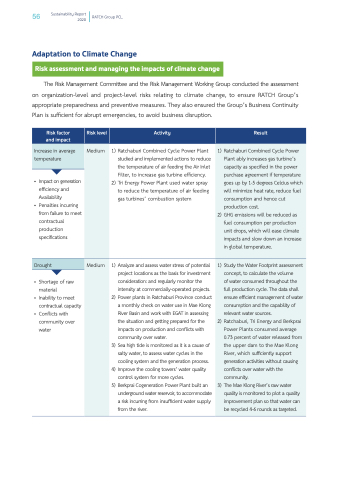
The Risk Management Committee and the Risk Management Working Group conducted the assessment on organization-level and project-level risks relating to climate change, to ensure RATCH Group’s appropriate preparedness and preventive measures. They also ensured the Group’s Business Continuity Plan is sufficient for abrupt emergencies, to avoid business disruption.
• Impactongeneration efficiency and Availability
• Penalties incurring from failure to meet contractual production specifications
• Shortage of raw material
• Inability to meet contractual capacity
• Conflicts with community over water
  Risk factor and impact
Increase in average temperature
Risk level
Medium
Activity
Result
      Drought
Medium
1) Ratchaburi Combined Cycle Power Plant studied and implemented actions to reduce the temperature of air feeding the Air Inlet Filter, to increase gas turbine efficiency.
2) Tri Energy Power Plant used water spray to reduce the temperature of air feeding gas turbines’ combustion system
1) Analyze and assess water stress of potential project locations as the basis for investment consideration: and regularly monitor the intensity at commercially-operated projects.
2) Power plants in Ratchaburi Province conduct a monthly check on water use in Mae Klong River Basin and work with EGAT in assessing the situation and getting prepared for the impacts on production and conflicts with community over water.
3) Sea high tide is monitored as it is a cause of salty water, to assess water cycles in the cooling system and the generation process.
4) Improve the cooling towers’ water quality control system for more cycles.
5) Berkprai Cogeneration Power Plant built an underground water reservoir, to accommodate a risk incurring from insufficient water supply from the river.
1) Ratchaburi Combined Cycle Power Plant ably increases gas turbine’s capacity as specified in the power purchase agreement if temperature goes up by 1-5 degrees Celcius which will minimize heat rate, reduce fuel consumption and hence cut production cost.
2) GHG emissions will be reduced as fuel consumption per production unit drops, which will ease climate impacts and slow down an increase in global temperature.
    1) Study the Water Footprint assessment concept, to calculate the volume
of water consumed throughout the full production cycle. The data shall ensure efficient management of water consumption and the capability of relevant water sources.
2) Ratchaburi, Tri Energy and Berkprai Power Plants consumed average 0.73 percent of water released from the upper dam to the Mae Klong River, which sufficiently support generation activities without causing conflicts over water with the community.
3) The Mae Klong River’s raw water quality is monitored to plot a quality improvement plan so that water can be recycled 4-6 rounds as targeted.


