


Page 90 - SD RATCH EN
P. 90
90
Sustainability Report 2020
RATCH Group PCL.
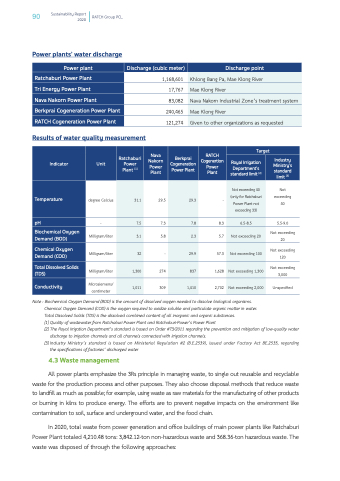
Power plants’ water discharge
  Power plant
 Discharge (cubic meter)
Discharge point
Ratchaburi Power Plant
 1,168,601
 Khlong Bang Pa, Mae Klong River
 Tri Energy Power Plant
17,767
Mae Klong River
 Nava Nakorn Power Plant
  83,082
  Nava Nakorn Industrial Zone’s treatment system
 Berkprai Cogeneration Power Plant
240,465
Mae Klong River
 RATCH Cogeneration Power Plant
  121,274
  Given to other organizations as requested
  Results of water quality measurement
  Indicator
  Unit
 Ratchaburi Power Plant [1]
Nava Nakorn Power Plant
  Berkprai Cogeneration Power Plant
RATCH Cogenertion Power Plant
  Target
  Royal Irrigation Department’s standard limit [2]
 Industry Ministry’s standard limit [3]
Temperature
degree Celcius
31.1
29.5
29.3
-
Not exceeding 40 (only for Ratchaburi Power Plant not exceeding 33)
Not exceeding 40
 pH
  -
  7.5
  7.3
  7.8
  8.3
  6.5-8.5
  5.5-9.0
 Biochemical Oxygen Demand (BOD)
 Milligram/liter
 3.1
 5.8
 2.3
 5.7
 Not exceeding 20
 Not exceeding 20
 Chemical Oxygen Demand (COD)
Milligram/liter
32
-
29.9
57.3
Not exceeding 100
Not exceeding 120
 Total Dissolved Solids (TDS)
  Milligram/liter
  1,300
  274
  837
  1,628
  Not exceeding 1,300
  Not exceeding 3,000
 Conductivity
 Microsiemens/ centimeter
 1,011
 309
 1,410
 2,702
 Not exceeding 2,000
 Unspecified
  Note : Biochemical Oxygen Demand (BOD) is the amount of dissolved oxygen needed to dissolve biological organisms. Chemical Oxygen Demand (COD) is the oxygen required to oxidize soluble and particulate organic matter in water. Total Dissolved Solids (TDS) is the dissolved combined content of all inorganic and organic substances.
[1] Quality of wastewater from Ratchaburi Power Plant and Ratchaburi-Power’s Power Plant
[2] The Royal Irrigation Department’s standard is based on Order #73/2011 regarding the prevention and mitigation of low-quality water discharge to irrigation channels and all channels connected with irrigation channels.
[3] Industry Ministry’s standard is based on Ministerial Regulation #2 (B.E.2539), issued under Factory Act BE.2535, regarding the specifications of factories’ discharged water
4.3 Waste management
All power plants emphasize the 3Rs principle in managing waste, to single out reusable and recyclable waste for the production process and other purposes. They also choose disposal methods that reduce waste to landfill as much as possible; for example, using waste as raw materials for the manufacturing of other products or burning in kilns to produce energy. The efforts are to prevent negative impacts on the environment like contamination to soil, surface and underground water, and the food chain.
In 2020, total waste from power generation and office buildings of main power plants like Ratchaburi Power Plant totaled 4,210.48 tons: 3,842.12-ton non-hazardous waste and 368.36-ton hazardous waste. The waste was disposed of through the following approaches:


