


Page 87 - SD RATCH EN
P. 87
4.1 Air quality management
RATCH-controlled power plants are mainly powered by natural gas, with some using diesel and bunker oil as secondary fuel.
RATCH Group PCL.
Sustainability Report 2020
87
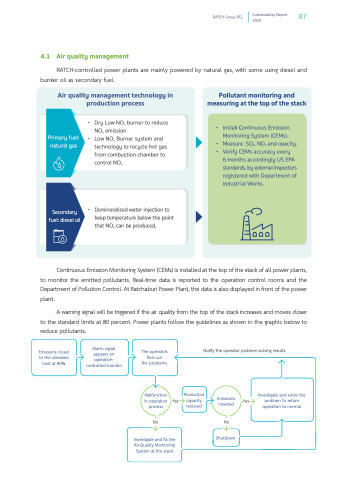
  Air quality management technology in production process
Pollutant monitoring and measuring at the top of the stack
• Install Continuous Emission Monitoring System (CEMs).
• Measure SO2, NOx and opacity.
• Verify CEMs accuracy every
6 months accordingly US EPA standards, by external inspectors registered with Department of Industrial Works.
    • Dry Low NOx burner to reduce NOx emission
Primary fuel: natural gas
Secondary fuel: diesel oil
• Low NOx Burner system and technology to recycle hot gas from combustion chamber to control NOx
• Demineralized water injection to keep temperature below the point that NOx can be produced.
   Continuous Emission Monitoring System (CEMs) is installed at the top of the stack of all power plants, to monitor the emitted pollutants. Real-time data is reported to the operation control rooms and the Department of Pollution Control. At Ratchaburi Power Plant, the data is also displayed in front of the power plant.
A warning signal will be triggered if the air quality from the top of the stack increases and moves closer to the standard limits at 80 percent. Power plants follow the guidelines as shown in the graphic below to reduce pollutants.
   Emissions closer to the standard limit at 80%
Alarm signal appears on operation- controlled monitor
The operators find out the problems
Malfunction in operation process
No
Notify the operator problem-solving results
  Yes
Production capacity reduced
Emissions lowered Yes
No
Shutdown
Investigate and solve the problem to return operation to normal
 Investigate and fix the Air-Quality Monitoring System at the stack


