


Page 101 - SD RATCH EN
P. 101
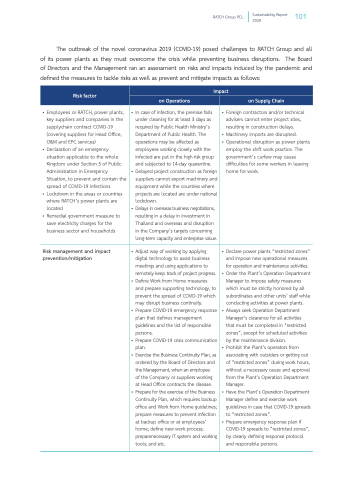
The outbreak of the novel coronavirus 2019 (COVID-19) posed challenges to RATCH Group and all of its power plants as they must overcome the crisis while preventing business disruptions. The Board of Directors and the Management ran an assessment on risks and impacts induced by the pandemic and defined the measures to tackle risks as well as prevent and mitigate impacts as follows:
RATCH Group PCL.
Sustainability Report 2020
101
 Risk factor
 Impact
 on Operations
  on Supply Chain
  • Employees or RATCH, power plants, key suppliers and companies in the supplychain contract COVID-19 (covering suppliers for Head Office, O&M and EPC services)
• Declaration of an emergency situation applicable to the whole Kingdom under Section 5 of Public Administration in Emergency Situation, to prevent and contain the spread of COVID-19 infections
• Lockdown in the areas or countries where RATCH’s power plants are located
• Remedial government measure to save electricity charges for the business sector and households
  • In case of infection, the premise falls under cleaning for at least 3 days as required by Public Health Ministry’s Department of Public Health. The operations may be affected as employees working closely with the infected are put in the high risk group and subjected to 14-day quarantine.
• Delayed project construction as foreign suppliers cannot export machinery and equipment while the countries where projects are located are under national lockdown.
• Delaysinoverseasbusinessnegotiations, resulting in a delay in investment in Thailand and overseas and disruption in the Company’s targets concerning long-term capacity and enterprise value.
 • Foreign contractors and/or technical advisers cannot enter project sites, resulting in construction delays.
• Machinery imports are disrupted.
• Operational disruption as power plants
employ the shift work practice. The government’s curfew may cause difficulties for some workers in leaving home for work.
  Risk management and impact prevention/mitigation
  • Adjust way of working by applying digital technology to assist business meetings and using applications to remotely keep track of project progress.
• Define Work from Home measures and prepare supporting technology, to prevent the spread of COVID-19 which may disrupt business continuity.
• Prepare COVID-19 emergency response plan that defines management guidelines and the list of responsible persons.
• Prepare COVID-19 crisis communication plan.
• Exercise the Business Continuity Plan, as ordered by the Board of Directors and the Management, when an employee
of the Company or suppliers working at Head Office contracts the disease.
• Prepare for the exercise of the Business Continuity Plan, which requires backup office and Work from Home guidelines; prepare measures to prevent infection at backup office or at employees’ home; define new work process; preparenecessary IT system and working tools; and etc.
 • Declare power plants “restricted zones” and impose new operational measures for operation and maintenance activities.
• Order the Plant’s Operation Department Manager to impose safety measures which must be strictly honored by all subordinates and other units’ staff while conducting activities at power plants.
• Always seek Operation Department Manager’s clearance for all activities that must be completed in “restricted zones”, except for scheduled activities by the maintenance division.
• Prohibit the Plant’s operators from associating with outsiders or getting out of “restricted zones” during work hours, without a necessary cause and approval from the Plant’s Operation Department Manager.
• Have the Plant’s Operation Department Manager define and exercise work guidelines in case that COVID-19 spreads to “restricted zones”.
• Prepare emergency response plan if COVID-19 spreads to “restricted zones”, by clearly defining response protocol and responsible persons.


