SDGs Alignment

RATCH has continuously followed the pathway to sustainability. Progress and achievements supported not only internal targets but also the United Nations Sustainable Development Goals (SDGs) for widespread impacts in economic, social and environmental dimensions.

Goal Implementation
Goal 3: Ensure healthy lives and promote well-being for all at all ages

Target 3.8 Achieve necessary and quality health service and access to safe, effective, quality and affordable essential medicines and vaccines.

  • Holding a 25% stake in 2 private hospitals - Princ Hospital Sakon Nakhon and Princ Mukdahan Hospital - which targets people in secondary cities for greater access to affordable healthcare services. Opened in 2023, Princ Hospital Sakon Nakhon provides tertiary care with 59 beds to residents in 3 Thai provinces and Lao PDR. Princ Mukdahan Hospital, with 59 beds, is the prototype digital platform and smart hospital in the Northeast, providing general healthcare services and care for complex diseases to residents in Mukdahan and nearby provinces as well as Lao PDR residents. It was inaugurated in December 2024.
  • Providing mobile clinic to Ratchaburi Power Plant’s neighboring communities for access to healthcare. The communities received preliminary medical examination and treatments by a team from Institute of Thai Traditional Medicine and Alternative Medicine, Muban Chombueng Rajabhat University. In 2024, the clinic served a number of 2,727 community members.
  • Investing, via a subsidiary RATCH-Lao Services Co., Ltd., in a 10% stake in Kasemrat International Hospital in Vientiane, Lao PDR. The 110-bed hospital was opened in 2021, targeting the residents in Lao PDR and neighboring countries.
Goal 4: Ensure inclusive and equitable quality education and promote lifelong learning opportunities for all

Target 4.4 By 2030, substantially increase the number of youth and adults who have relevant skills, including technical and vocational skills, for employment, Decent jobs and entrepreneurship.

Implementing the Education for Career Empowerment Project in Lao PDR, in collaboration with the Ministry of Education and Sports, since 2009, to improve the quality of vocational education in Lao PDR in electric control, metal welding, machinery, general maintenance, and renewable energy fields. Organized activities encompassed training for vocational teachers in target fields; training for students, field trips, High vocational Certificate scholarships for teachers, development of training courses, installation of modern equipment and workshop improvement, and solar panel installation for neighboring community. Seven vocational colleges participated in the project. During 2009 and 2024, RATCH awarded a total of 50 high vocational-level and bachelor-degree scholarships; catered skill development intensive training in target fields for 1,646 final-year students; catered training to 134 teachers; and developed related curriculum and training courses. A number of 872 students have passed the comprehensive training and successfully applied for jobs, while 405 students have pursued higher studies.

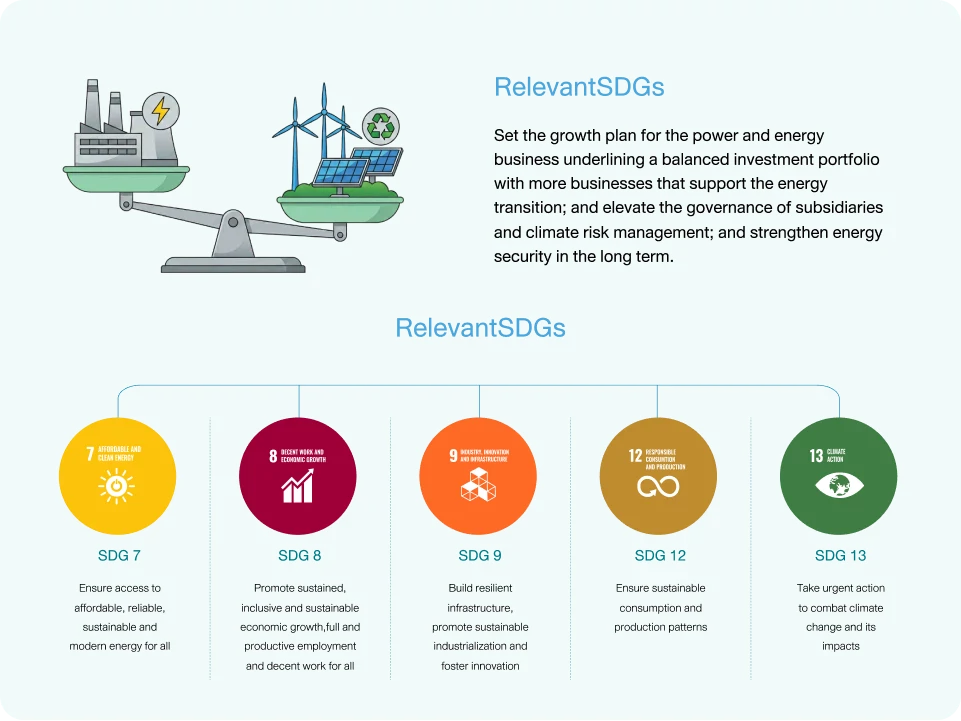
Goal 7: Ensure access to affordable, reliable, sustainable and modern energy for all

Target 7.2 By 2030, increase substantially the share of renewable energy in the global energy mix.

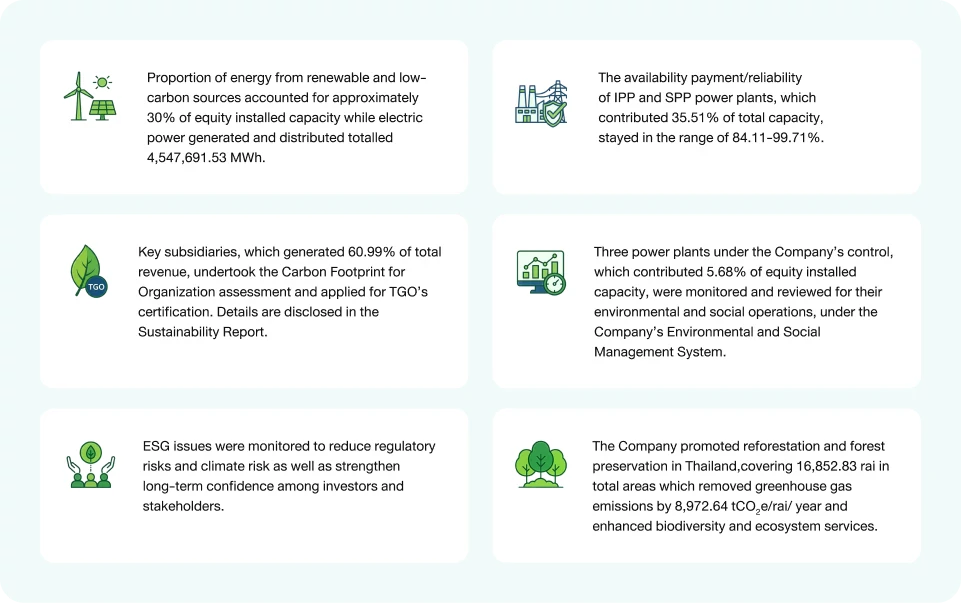
Investing more in renewable energy under the Climate Change Strategy. As of 2024, the proportion of renewable electricity generation from investment projects in Thailand, Lao PDR, Australia, Indonesia, Vietnam, the Philippines and Japan reached 2,972.22 MW or 27.48% of total capacity. Renewable electricity distribution in 2024 totaled 4,307,864 megawatt-hours. There is a plan to raise the renewable electricity generation capacity to 30% and 40% of total capacity in 2030 and 2035, respectively.

Goal 8: Promote sustained, inclusive and sustainable economic growth, full and productive employment and decent work for all

Target 8.7 Take immediate and effective measures to eradicate forced labor, end modern slavery and human trafficking and secure the prohibition and elimination of the worst forms of child labor, including recruitment and use of child soldiers, and by 2025 end child labor in all its forms.

Target 8.8 Protect labor rights and promote safe and secure working environments of all workers, including migrant workers, particularly women migrants, and those in precarious employment.

  • Enforcing the Human Rights Policy and Supplier Code of Conduct and ensuring strict compliance across the Company Group to achieve the targets of zero violation of the human rights of all rights-holders related to the operations and zero use of all forms of child labor and forced labor. In 2024, none of rights-holders filed a complaint and there was no employment of child labor.
  • Defining the occupational health and safety guidelines for both employees and suppliers under the operational regulations on occupational health and safety which demands strict and full compliance from all job operators. All activities demand risk assessment, permits for work, supervision and examination of work environment, to ensure safety and zero injuries or work-related illness for both employees and suppliers.
Goal 12: Ensure sustainable consumption and production patterns

Target 12.5 By 2030, substantially reduce waste generation through prevention, reduction, recycling, and reuse.

Target 12.6 Encourage companies, especially large and transnational companies, to adopt sustainable practices and to integrate sustainability information into their reporting cycle.

  • Utilizing resources efficiently, reducing waste at source, and managing waste appropriately for least impacts. The targets are set to reduce Ratchaburi Power Plant’s water consumption per unit of distributed electricity by 1% and maintain each power plant’s heat rate at the prescribed level. In 2024, Ratchaburi Power Plant’s water consumption per unit of distributed electricity decreased by 0.7% from the previous year while the heat rate of 4 power plants (50%) met the target.
  • Managing waste appropriately, in 2024, Songkhla Biomass Power Plant used tree root waste as fuel, further reducing waste volume by 2.5%. Other power plants used external waste processors’ disposal services, instructed them to start with reuse or recycling. The rest of waste is then incinerated for energy or burnt without energy. All avoid sending leftover hazardous waste to landfills, resulting in a 92% decrease in hazardous waste to landfills.
  • Preparing the annual Sustainability Report in alignment with the GRI Standards to disclose the sustainability operations of the Company Group and obtaining the assurance statement from external verifiers.
Goal 13: Take urgent action to combat climate change and its impacts

Target 13.3 Improve education, awareness-raising and human and institutional capacity on climate change mitigation, adaptation, impact reduction and early warning

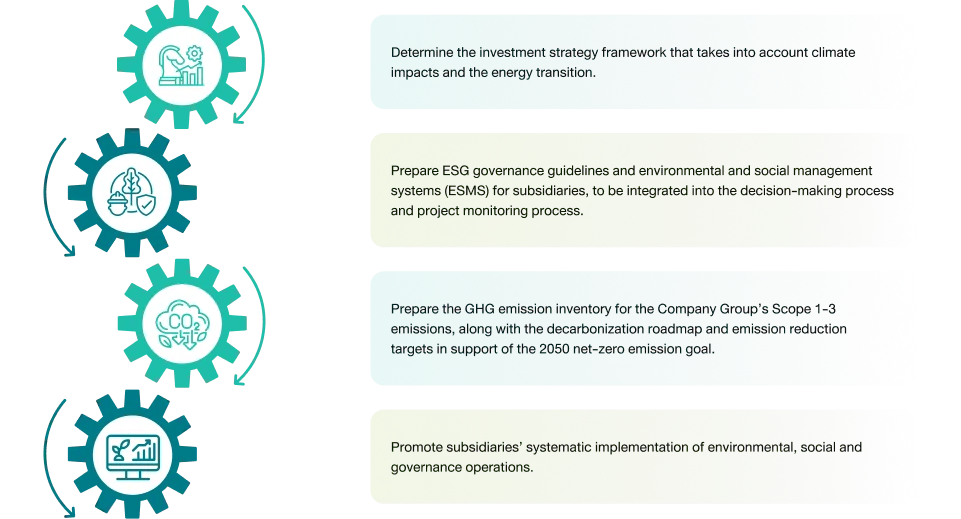
  • Steering forward the Climate Change strategy and follow the Decarbonization Roadmap to reduce direct and indirect emissions and remove greenhouses gases. The Company Group’s personnel received the capacity-building training on Carbon Footprint for Organization calculation, internal carbon pricing, TCFD disclosure framework, and the requirements under the Climate Change Act.
  • Collaborating with communities in mitigating climate impacts, with the education on GHG removals and supports to related activities. In 2024, RATCH continued its collaboration with various parties in terrestrial and mangrove reforestation, to increase forest areas and carbon sinks and carbon credits. It also supported forest preservation through the Love the Forests and the Community Project, with knowledge in the management, development, restoration and maintenance of community forest and ecosystems, for biodiversity, GHG sequestration, dust absorption and protection against natural disasters.
Goal 14: Conserve and sustainably use the oceans, seas and marine resources for sustainable development

Target 14.2 Sustainably manage, and protect marine and coastal ecosystems to avoid significant adverse impacts, including by strengthening their resilience and taking action for their restoration, to achieve healthy and productive oceans by 2020.

Collaborating with the Department of Marine and Coastal Resources in expanding mangrove forests in Chanthaburi province, to reduce coastal erosion, build the habitat and nursery for aquatic lives, and enhance biodiversity. The 113.47-rai reforestation area was registered under TGO’s T-VER Scheme in 2024, with estimated GHG sequestration capacity of 3,120 tCO2e in a 10-year period (2023-2033). It is also expected to enhance the ecological balance.

Goal 15: Protect, restore and promote sustainable use of terrestrial ecosystems, sustainably manage forests, combat desertification, and halt and reverse land degradation and halt biodiversity loss

Target 15.1 Ensure the conservation, restoration and sustainable use of terrestrial and inland freshwater ecosystems and their services, in particular forests, wetlands, mountains and drylands, in line with obligations under international agreements.

Target 15.2 Promote the implementation of sustainable management of all types of forests, halt deforestation, restore degraded forests and substantially increase afforestation and reforestation globally.

  • Collaborating with the Department of Royal Forest in increasing green areas and reinforcing community strength through engagement in community forest and biodiversity management. The project, covering 6,034 rai, calls for the reforestation on degraded areas and community forest preservation and is expected to sequester 23,064.75 tCO2e of greenhouse gases throughout the 15-year period. It is also expected to raise conservation awareness and create ecological balance and economic benefits to the communities.
  • Supporting Mae Fah Luang Foundation under Royal Patronage’s 11,000-rai community forest conservation project. Implemented in collaboration with communities, the project is expected to create carbon credits, restoring forest biodiversity and reinforce community strengths.