


Corporate Citizenship
The corporate social responsibility focuses on community and social development to promote and support environmental conservation projects, energy conservation activities as well as enhancing living quality of people in communities and society at large in line with the Company’s strategy and business operations under the Company’s sustainability development policy and the social and environment policy which is governed by the corporate governance and sustainability committee
| More Info: | Corporate Governance and Sustainability Committee |
| Environmental and Social Policy | |
| Corporate Sustainability Policy |
Community and Social Management Structure

Significant community and social actions in 2025
RATCH Group has been committed to creating sustainable value and growth to community and society through an emphasis on these 5 aspects considered the cornerstones of quality of life:

Education for Career Empowerment Project in Lao PDR
RATCH strives to conduct business with sustainability in mind, to deliver value to community and society at all operating areas. For communities in Lao PDR, aside from economic value, the “Education for Career Empowerment Project” is a highlight of the Company’s sustainability strategy in social dimension. Initiated in 2011 after the incorporation of a subsidiary in Lao PDR, the main business base for energy project development in neighboring countries, the project has been carried out continuously. It is currently in the third phase (2024-2030).
The project has been implemented in collaboration with Lao PDR’s Ministry of Education and Sports. Activities are jointly designed in accordance with the country’s vocational education development strategy, to support the development of human resources in the areas where the Company operates. The project emphasizes the strengthening of vocational teachers and students’ technical knowledge and skills required in the industrial and renewable energy sectors. It also aims to develop advanced labor skills to meet the labor needs of Lao PDR, and lay the foundation of renewable energy education at the vocational level, in alignment with the country’s economic and social development strategy. While the project produces personnel for the Company’s business, it supports the United Nations Sustainable Development Goals – Goal 4: Quality education, and Goal 8: Decent work and economic growth.
In the third phase, the goal is elevated to emphasize community access to energy sources, especially renewable energy to reduce dependencies on external supply and greenhouse gas emissions. In focus are solar power, wind power, energy from waste, and energy crops. Teachers and students gain more knowledge in renewable energy while participating in field training on the installation and maintenance of solar panels in needy communities, which hence creates sustainable environmental and social value.

Progress in 2025
| Activities | Target group | Participants (person) |
|---|---|---|
| Training and practical work experience for senior vocational students | Senior vocational students | 194 |
|
Vientiane Province Technical College | 45 |
|
Pak Pa Sak Technical College | 20 |
|
Vientiane Province Technical College | 20 |
| Integrated Technical-Vocational School of Bolikhamxay Province | 22 | |
| Integrated Technical-Vocational School of Houaphanh Province | 20 | |
| Luang Pra Bang Province Technical College | 22 | |
|
Integrated Technical-Vocational School of Auttapue Province | 25 |
|
Integrated Technical-Vocational School of Sekong Province | 20 |
Operational results
|
||
| Activity | Target group | Scholarship |
|---|---|---|
|
Bachelor degree student | 11 |
| High vocational degree student | 29 | |
Operational results
|
||
| More Info: | SROI-based impact assessment |
Career promotion and development
| Actions | Results |
|---|---|
| Career training |
|
| Supporting community enterprise products |
|
Health prevention and healthcare for community
| Actions | Results |
|---|---|
| Blood donation to celebrate His Majesty King Vajiralongkorn’s birthday |
|
| Promotion of health and public health knowledge to local community/agencies |
|
| Emergency response plan drill |
|
| Mobile medical unit |
|
Sharing to society and community
| Actions | Results |
|---|---|
| Donation and sharing |
|
| Supports to the victims of natural disasters (flooding) |
|
| Security watch |
|
| Promotion and support to community tradition and culture |
|
| Fixing and improvement of accommodation, infrastructure and utilities |
|
| Promoting quality of life and equality of living |
|
Environment and resources
Love the Forests and the Community Project
The Love the Forests and the Community Project continued in 2025 for the 18th consecutive year under the original aspiration, in collaboration with the Department of Royal Forest (DRF) and communities. The project seeks to promote sustainable community forest management for community benefits and peaceful coexistence, with communities playing the role in preserving forests and using the forests as sources of food and income through ecotourism activities. The forests are also local learning centers in terms of water and biodiversity management. Forest ecosystems help prevent natural disasters and a source of herbs and provide medicinal herbs. The project aims to encourage forest protection and spread the conservation drive to other communities with a model of forest care, conservation and development. As more communities can establish their community forests, it will increase the abundance of natural resources at both the local and national levels. It is an approach to support SDG 13: Take urgent action to combat climate change and its impacts.

Love the Forests and the Community Contest 2025 16 awards,
with prize money of THB 1,450,000
| Survey: awarded forests allocation of prize money | |||
|---|---|---|---|
| Management | Activity | Prize money (Baht) | % |
| Restoration | Reforestation / green area enhancement | 249,500.00 | 17.21 |
| Moisture-retaining dykes | 163,000.00 | 11.24 | |
| Preservation | Patrolling | 299,800.00 | 20.68 |
| Wildfire prevention equipment and firebreaks | 212,000.00 | 14.62 | |
| Traditional cultural activities (e.g., tree ordination ceremonies or other local traditions) | 30,200.00 | 2.08 | |
| Development | Nature trails and learning / tourist centers | 327,500.00 | 22.58 |
| Capacity-building training on conservation and community forest management | 70,000.00 | 4.83 | |
| Community product development | 80,000.00 | 5.52 | |
| Plant genetic conservation-carbon sequestration activities | 18,000.00 | 1.24 |
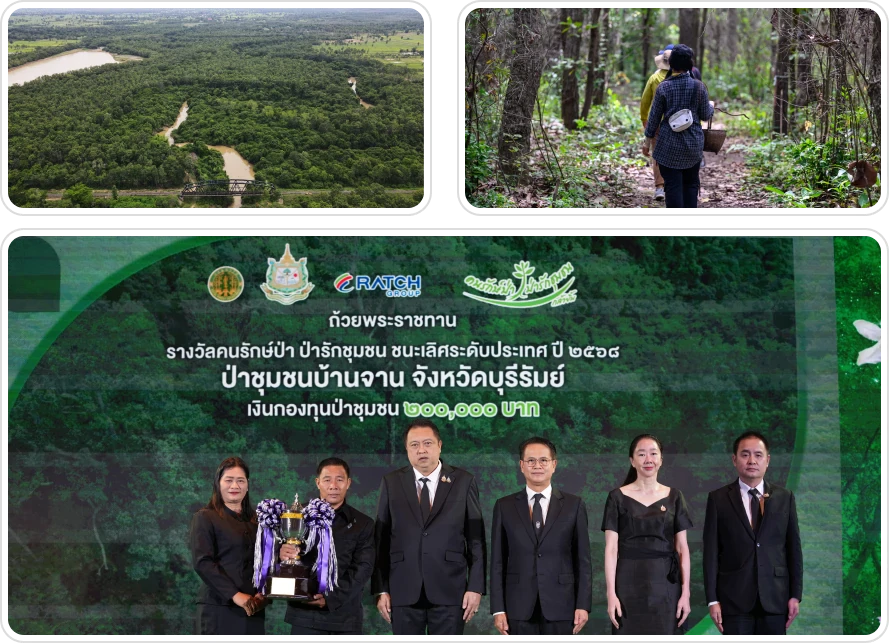
Example of value multiplying at “Ban Chan Community Forest” in Buriram Province, winner of the National Community Forest Award
Ban Chan Community Forest is located in Moo 6, Nong Teng subdistrict, Krasang District, Buriram Province. Covering 891 rai and 313 square wah, it is a dry and mixed dipterocarp forest. The lush forest is a food source to the community and a learning center for nature enthusiasts.
By winning the Love the Forests and the Community Contest, Ban Chan Community received the prize money worth THB 200,000. The amount was deposited to the central account, reserved for the forest management in 3 dimensions: 1) 35% to restoration through reforestation for more green areas, 2) 35% to development through an improvement of nature trails as a community learning center or probably a natural attraction, and 3) 30% to conservation that involves patrolling, monitoring and prevention of encroachment. The prize money will reinforce the community’s efforts in continuing with its mission in an efficient way.
Example of value multiplying at Ban Huay Kong Loh Community Forest in Lamphun Province, the outstanding community forest in response to natural disasters
Ban Huay Kong Loh Community Forest is located in Moo 9, Pa Phlu Subdistrict, Ban Hong District, Lamphun Province. Spreading 3,750 rai, it is a dry dipterocarp and mixed forest. The hilly forest is the home of numerous large and small creeks that support agricultural activities, nature learning and tourism.
The community has implemented activities in response to natural disasters, particularly wildfires. In this regard, the response includes firebreaks, wildfire check and suppression points, leave containers, patrolling, construction of check dams, a community wildfire management plan, an education campaign for community members of all ages, assessment of risks and preventive measures, an emergency plan drill, access screening, and first-aid training. The management process is comprehensive, covering the prevention, incident tackling, correction, impact mitigation and remediation.
Aside from wildfires, the community has plans for flooding and landslides, by analyzing water flow and landslide paths; identifying risk areas; preparing personnel, tools and equipment for rescue operations; growing trees to increase moisture and prevent soil erosion; and planting of vetiver grass on the banks of creeks or slopes to prevent soil erosion.
By winning the Love the Forests and the Community Contest, Ban Huay Kong Loh Community Forest received the prize money worth THB 50,000. The amount was deposited to the community forest’s central account for continuous forest management. The prize money will be allocated to: 1) restoration activities – 14% for green area expansion and 20% for more check dams to lock in moisture and maintain the abundance, and 2) conservation activities – 60% for wildfire fighting equipment and materials and the making of firebreaks and 6% for patrolling against encroachment and other incidents. The prize money will help reinforce the community’s strengths in preventing unwanted incidents in its forest, so as to further maintain the forest fertility.
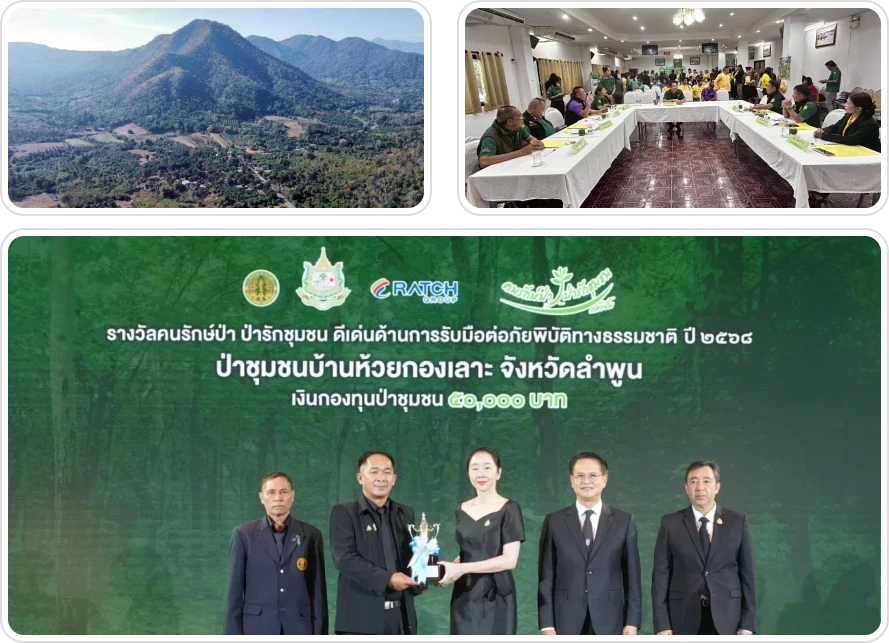
Positive impacts on community
The award-winning community forests have created positive impacts from benefits to households to the creation of economic value, jobs and income and supports to daily life, by being the sources of food and learning centers. They are also considered important natural resources that help protect communities from natural disasters such as drought and flooding. The positive impacts spread to a number of 3,375 households or about 12,106 people whose life and livelihood depend on these forests.
| Economic dimension | Social dimension | Environmental dimension |
|---|---|---|
|
|
|
Plant Genetic Conservation Project Under the Royal Initiative of HRH Princess Maha Chakri Sirindhorn (RSPG)
RATCH was granted the royal approval to join the initiative in 2017 under the sixth phase of RSPG’s 5-year masterplan. The project, entitled the Plant Genetic Conservation Project Under the Royal Initiative of HRH Princess Maha Chakri Sirindhorn by RATCH Group Public Company Limited, was launched and has continued under the seventh phase of the masterplan, to carry on the royal wish of His Majesty King Bhumibol Adulyadej The Great with deepest gratitude to His Majesty’s boundless benevolence. In this regard, RATCH participated in the 8th Activities: Special activities for Supporting Plant Genetic Conservation, involving training on school botanical gardens and local natural resources.

Throughout the period that the Company has joined the Plant Genetic Conservation Project Under the Royal Initiative of HRH Princess Maha Chakri Sirindhorn (RSPG), RATCH has continuously promoted knowledge under RSPG’s awareness-raising framework to provide guidance to local administrative offices in planning and scaling up resource conservation within their offices. During 2018 and 2025, RATCH had organized workshops for 27 classes, or 1,972 participants.
| More Info: | Plant Genetic Conservation Project Under the Royal Initiation of Her Royal Highness Princess Maha Chakri Sirindhorn (RSPG) |
Management of forest carbon credits under Sustainability Strategy
RATCH and all subsidiaries have implemented 6 projects for carbon credits under Thailand Voluntary Emission Reduction Program (T-VER), involving terrestrial and mangrove reforestation and supports to community forest conservation. Aside from the amount of carbon credits, these projects have yielded mutual benefits for communities and their localities in various dimensions as detailed below:
| Project Description | Project Description Benefits |
|---|---|
Terrestrial reforestation, Chonburi Province
|
|
Mangrove reforestation, Chanthaburi Province
|
|
Conservation of 7 community forests in the Central Region, the Northeast and the North
|
|
Reforestation at Ratchaburi Power Plant
|
|
Other natural resource and environmental conservation projects
| Actions | Results |
|---|---|
| Ecosystem restoration and resource conservation |
|
| Greenhouse gas emission reduction |
|
| Waste management |
|
| Training and knowledge development |
|
Community satisfaction
The power plants have continuously conducted community opinion surveys, to ensure that their operations meet standards and gain acceptance and trust from relevant stakeholders. The surveys cover topics such as the production process, management of environmental and safety issues, and promotion of the quality of life of community and society. The surveys are a way to reflect the power plants’ performance and lead to further improvement, so that the power plants can meet the needs of community and optimize their benefits.
| Community satisfaction survey in 2025 | ||
|---|---|---|
| Entity | Actions | Satisfaction score: Moderate-Very High |
| RATCH Cogeneration Power Plant | Responding to questionnaires were the general public, community leaders, local leaders and relevant government offices within 5-km radius | 87.10 |
| RATCH Energy Rayong Power Plant | 100.00 | |
| RATCH Pathana Energy | 88.91 | |
| Hinkong Power Plant | 84.11 |
Sharing value with community and society
In 2025, RATCH maintained its aspiration to grow business in tandem with the quality-of-life improvement for community and society, through investments, activities and value sharing in various forms, totaling more than THB 1,338.42 million.
| Shared value | Baht |
|---|---|
| Income Tax (contributed to the government for national development) | 1,122,829,586 |
| Local taxes (contributed to the government to support local development) | 16,392,818 |
| Power Development Fund (contributed to the fund for managing activities related to the power plant) | 127,745,295 |
| CSR Project | 47,533,646 |
| Donation | 23,916,232 |