


GHG Management
Emission amount in 2024
The 11 power plants under RATCH’s operational control (contributing 80.06% of total revenue) have calculated the carbon footprint for organization or the volume of greenhouse gas emissions from direct and indirect activities (Scope 1-3), in order to assess the performance and devise emission reduction plans in the following years, particularly with collaboration from upstream suppliers.
| Indicators | Unit | 2022 | 2023 | 2024 |
|---|---|---|---|---|
| Volume of direct emissions (Scope 1) | tCO2e | 8,515,787 | 4,984,325 | 5,296,098 |
| Volume of indirect emissions (Scope 2) from purchased electricity (location-based method) |
tCO2e | 31,367 | 28,363 | 39,387 |
| Volume of indirect emissions (Scope 2) from purchased electricity (market-based method) |
tCO2e | 31,367 | 28,363 | 39,387 |
| Volume of other indirect emissions (Scope 3) | tCO2e | 3,113,000 | 1,549,089 | 1,769,016 |
| Greenhouse gas emission intensity: Scope 1 and 2 emissions per unit of electricity | tCO2e /MWh | 0.4172 | 0.3874 | 0.3247 |

RATCH’s power plants in Thailand in the scope of reporting emitted 0.3247 tCO2e/MWh of greenhouse gases, or lower than the Grid Emission Factor. The emissions showed a 28.9% decrease from the base year 2015, while RATCH targets to reduce the emissions by 15% in 2030 from the base year 2015 (at 8,694,192 tCO2e) and achieve Net Zero Emissions by 2050
Carbon footprint assessment
The carbon footprint calculation in 2024 entailed RATCH Group’s Head Office and 7 power plants including newly-included 770-MW Hin Kong Power Plant Unit 1, a gas-fired combined cycle power plant in Ratchaburi province. Commencing commercial operations in March 2024, the power plant concurrently started the calculation of carbon footprint for organization to get the data from the start for the setting of more effective emission reduction goals in the following years.
The calculation of all power plants and Head Office is pending for the verification and assurance by independent third party and the verification by Thailand Greenhouse Gas Management Organization (Public Organization). It is considered a part of RATCH’s preparation for the upcoming disclosure rules.
| Amount of emissions (tCO2e) based on carbon footprint for organization (CFO) assessment | ||||||||||||
|---|---|---|---|---|---|---|---|---|---|---|---|---|
| Power plant | Direct emissions (Scope 1)
|
Indirect emissions (Scope 2)
|
Other indirect emissions (Scope 3)
|
|||||||||
| Year | Base year | 2022 | 2023 | 2024* | Base year | 2022 | 2023 | 2024* | 2022 | 2023 | 2024* | |
| Ratchaburi | 7,128,375 (2015) |
6,302,398 | 2,823,958 | 1,713,306 | 27,702 (2015) |
22,270 | 19,965 | 17,872 | 2,729,674 | 1,179,998 | 949,311 | |
| RATCH Cogeneration | 300,854 (2021) |
307,544 | 316,014 | 328,285 | 1,069 (2021) |
149 | 32 | 0 | 88,316 | 53,234 | 54,383 | |
| Nava Nakorn Electricity | 515,185 (2021) |
485,947 | 488,613 | 476,479 | 50 (2021) |
31 | 0 | 0 | 142,845 | 89,866 | 79,363 | |
| Berkprai Cogeneration | - | - | 261,923 | 250,735 | - | - | 186 | 113 | - | 56,776 | 56,234 | |
| RATCH Energy Rayong | - | - | 211,523 | 236,046 | - | - | 214 | 107 | - | 35,158 | 49,032 | |
| Ratch Pathana Energy | 533,254 (2022) |
533,254 | 474,331 | 353,952 | 463 (2022) |
463 | 511 | 618 | 140,022 | 134,057 | 99,556 | |
| Hin Kong (Unit 1)** | Commencing operations in 2024 | 1,637,017 | - | 7,818 | - | 453,817 | ||||||
| Head Office | 73 (2018) |
58 | 802 | 76 | 1,110 (2018) |
846 | 811 | 849 | 46 | 50 | 2,339 | |
| Note: | * Under verification process |
| ** Hin Kong Power Plant (Unit 1) commenced operations and carbon footprint calculation in 2024. |
GHG reduction targets and performance
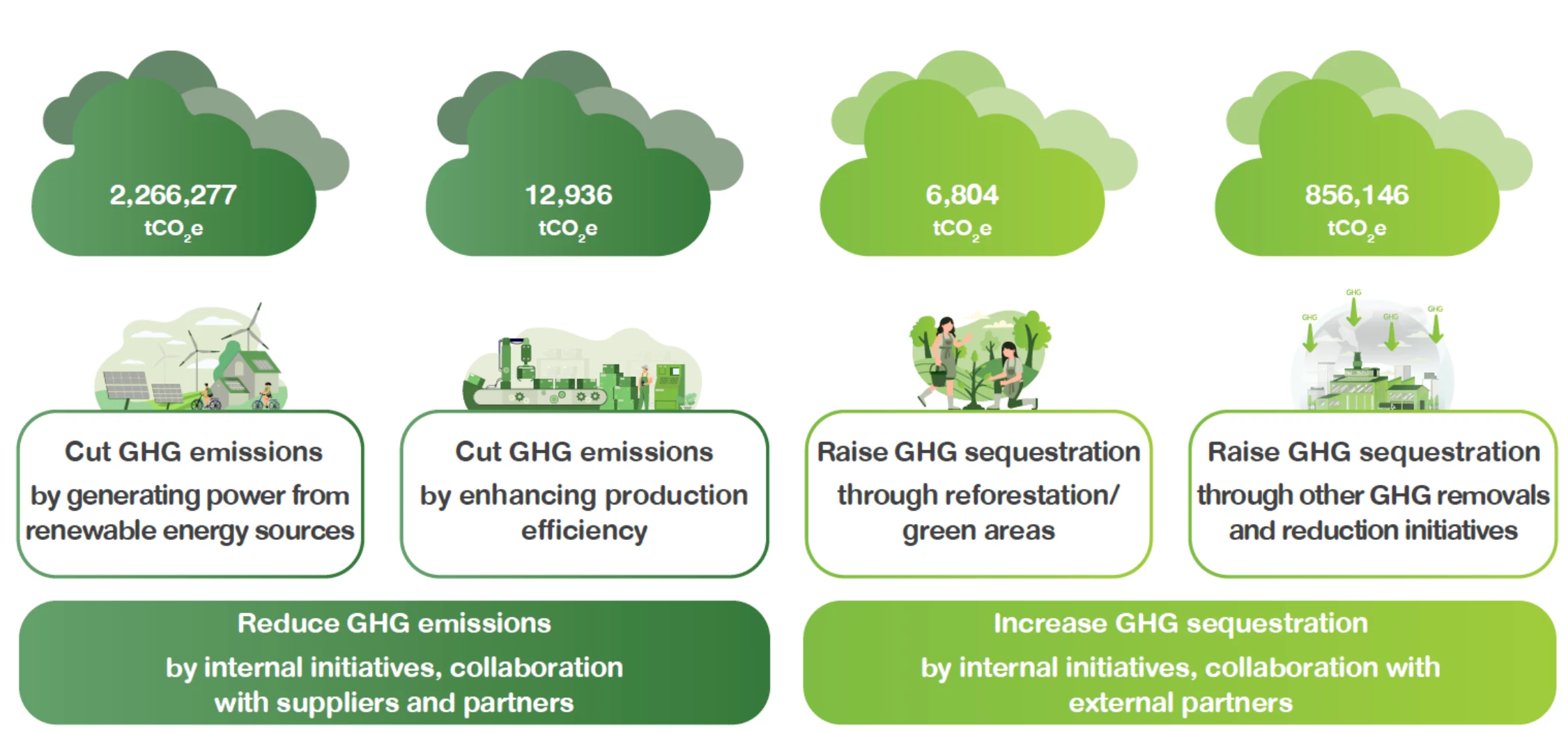
RATCH Group has made consistent efforts in reducing greenhouse gas emissions and witnessed tangible progress in the investment in renewable energy power plants that rely on solar power, wind power, hydropower and biomass; production efficiency enhancement through lower fuel and energy consumption; an increase in carbon sinks; and direct and indirect preservation of carbon sinks.
Progress in 2024
Renewable energy utilization
In 2024, RATCH continued to harness power from renewable energy sources for electricity generation. The proportion of equity installed capacity from renewable power plants in Thailand and abroad is now 27.5% (from 30% target set for 2030). The renewable power plants generated and distributed 4,307,864 megawatt-hours in 2024, 17% of total output.
| Renewable energy sources | Capacity (MW) | Volume of distribution (MWh) | Change | Remark |
|---|---|---|---|---|
| Equity-based | ||||
| 1. Wind energy | 891.75 | 2,338,581 | Decrease 2% | In 2024, capacity increased from 2 power plants;
|
| 2. Solar energy | 125.11 | 156,546 | Increase 16% | |
| 3. Hydro energy | 589.53 | 1,718,350 | Increase 6% | |
| 4. Biomass | 11.83 | 94,387 | Increase 2% | |
Production efficiency enhancement
All power plants have restlessly pursued new ways to operate machinery and equipment, in order to improve the energy efficiency in the production process. This endeavor lowers emissions per unit of distributed electricity and reduces the Scope 2 GHG emissions of customers.
In 2024, the 7 power plants as well as Head Office implemented 25 projects to enhance the production and energy efficiency, resulting in 80,768 million BTU of saved heat rate and 2,207 MWh of saved electric power equivalent to 12,936 tCO2e.
| Power Plant/Office | No. of projects/activities | Target of energy saving (MMBTU) | Target of Electric Power saving (MWh) | Heat rate reduced (MMBTU/year) | Electric power saved (kilowatt-hour/ year) | Cost saving (Baht/year) | Investment (Baht) | GHG emission Reduced (tCO2e) |
|---|---|---|---|---|---|---|---|---|
| Ratchaburi | 4 | - | 57.1 | 0 | 1,108,454 | 3,347,530 | 0 | 554 |
| Nava Nakorn Electricity | 1 | 30,313 | 0 | 31,786 | - | 686,631 | - | 4,657 |
| Berkprai Cogeneration | 2 | 1,046 | 3.96 | 3,545 | 3,487 | 823,767 | 0 | 521 |
| RATCH Cogeneration | 3 | - | 400 | 0 | 224,937 | 708,102 | 1,936,000 | 112 |
| RATCH Energy Rayong | 4 | - | 640.68 | 0 | 640,680 | 2,562,721 | 0 | 320 |
| RATCH Pathana Energy Group | 7 | 11,202 | 115.63 | 7,116 | 167,696 | 1,800,829 | 1,529,623 | 1,126 |
| Songkhla Biomass | 2 | 75,598 | 9.13 | 38,321 | 9,280 | 7,557,733 | 240,000 | 5,619 |
| RATCH Group HQ | 2 | - | 41.39 | 0 | 52,329 | 240,285 | 26,750 | 26 |
| Total | 25 | 118,159 | 1,267.89 | 80,768 | 2,206,863 | 17,727,597 | 3,732,373 | 12,936 |
Carbon sinks for GHG removals
In 2024, RATCH took the leading role in implementing the Company Group’s projects under the Thailand Voluntary Emission Reduction Program (T-VER): terrestrial and mangrove reforestation and community forest supports for carbon credits. In addition, via a community forest contest under the Love the Forests and the Community Project which started in 2008, RATCH extended its supports to the management and preservation of nationwide community forests. The activities created carbon sinks for the removals and sequestration of atmospheric greenhouse gases, hence reducing the intensity and contributing to the abundance and balance of the ecosystem for the quality of life of communities and society.
Group’s contribution to carbon sinks
| Forestry and green space projects | Collaborator/Initiator | Area (rai) | Period of credit calculation | Volume of carbon credits (tCO2e/year) | T-VER Registration/Carbon credit certification | |
|---|---|---|---|---|---|---|
| Total credits | Credits for RATCH/year | |||||
| RATCH Group PCL. | ||||||
| Forest conservation project to enhance biodiversity and create carbon sinks under Thailand Greenhouse Gas Management’s T-VER scheme (Klong Takien Forest in Kasetsuvarn Subdistrict, Bo-Tong District, Chonburi Province) | Department of Royal Forest | 339 | 15 years (17/07/24-30/09/39) |
4,830.75 (or 322.05 tCO2e/year) |
289.85 (90%) |
Expectation T-VER registration in 2025 and verify carbon credit in 2030 |
| Mangrove reforestation for carbon credits | Department of Marine and Coastal Resources | 113.47 | 10 years (24/08/23-23/08/33) |
3,120 (or 312 tCO2e/year) |
280.8 (90%) |
T-VER registration in 2024 and verify carbon credit in 2027 |
| Forest Carbon Credits Management for Sustainable Development Project (Bannacharoen community forest, Chaing-rai Province) | Mae Fah Luang Foundation | 1,000 | 5 years (2022-2027) (Purchasing carbon credits for a 3-year period from 2022 to 2025) |
1,653.54 (or 551.18 tCO2e/year) |
551.18 (as project agreement) |
T-VER registration in 2024 and verify carbon credit in 2025 |
| Forest Carbon Credits Management for Sustainable Development Project (community forests in the North and Northeast) | Mae Fah Luang Foundation | 10,000 | 5 years (2023-2028) (Purchasing carbon credits for a 3-year period from 2023 to 2026) |
16,404.21 (or 5,468.07 tCO2e/year) |
5,468.07 (as project agreement) |
T-VER registration in 2024 and verify carbon credit in 2026 |
| Preservation, restoration and management of 5 community forests in Sa Kaeo, Khon Kaen and Nakhon Ratchasima provinces for GHG emission reduction | Department of Royal Forest | 3,195 | 15 years (2024-2038) |
25,879.5 (or 1,725.3 tCO2e/year) |
862.65 (50%) |
T-VER registration in 2025 and verify carbon credit in 2030 |
| Preservation, restoration and management of 2 community forests in Phrae Province | Department of Royal Forest | 2,500 | 15 years (2024-2038) |
20,250 (or 1,350 tCO2e/year) |
675 (50%) |
Registration in 2025 |
| Ratchaburi Electricity Generating Co., Ltd. | ||||||
| Ratchaburi Power Plant’s sustainable reforestation project | 47.92 | 20 years (01/09/19-31/08/39) |
1,140 (or 57 tCO2e/year) |
57 (certified for the first three years 390 tCO2e) |
The next round of carbon credits certification in 2027 | |
Supports to carbon sinks/removals
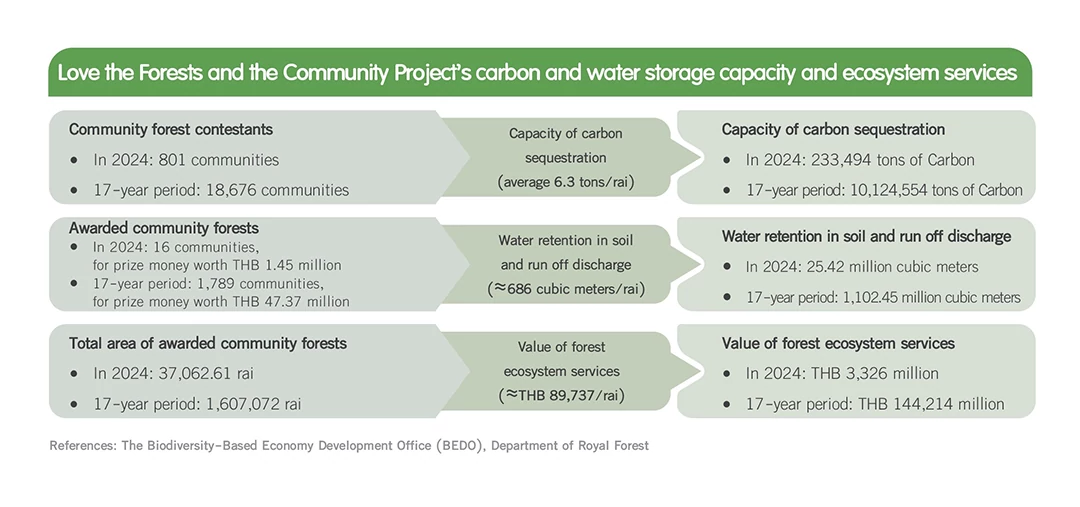
RATCH has proceeded with its supports to community forests nationwide via the Love the Forests and the Community Project. The Community Forest Contest 2024 offered prize money to the 16 forests winning the national-level and regional-level awards as well as the awards for outstanding development. Located in the North, the Northeast, the South, the East and the Central Region, the forests span 37,062.61 rai and are able to sequester approximately 233,494 tons of carbon or equivalent to 856,146 tons of greenhouse gases. The forests also help store groundwater, discharge runoff, and with biodiversity create a huge value of ecosystem services.
Human resource capability enhancement to cope with climate change
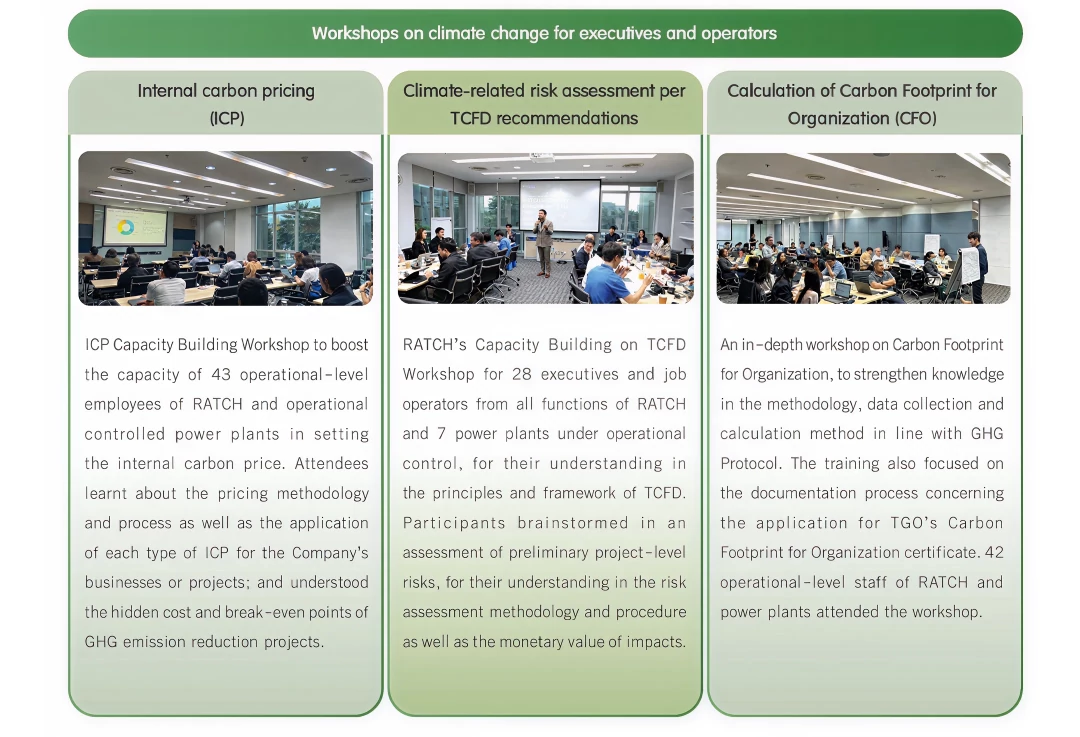
In 2024, RATCH enhanced climate-related knowledge and skills for relevant personnel, so that they can apply the knowledge with work processes designed to cope with emerging risks in the near future as well as legal and regulatory amendments. The future legislation is also anticipated to be tougher, to hold all parties responsible for the emissions from their activities, in an effective way and in alignment with the country’s requirements and goals.
Internal carbon pricing (ICP)
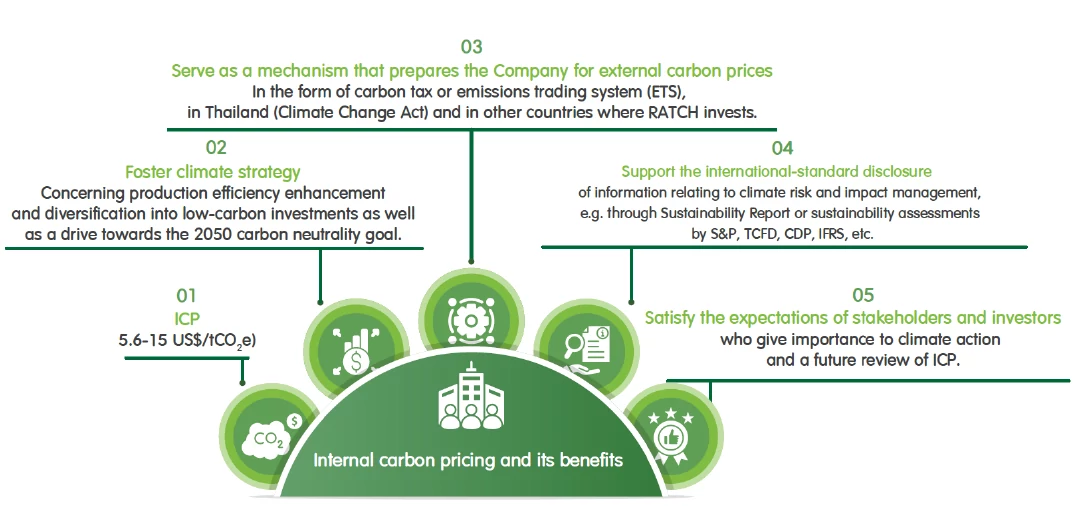
RATCH initiated the internal carbon pricing (ICP) study as part of the Climate Change Strategy, so as to know the internal carbon price which will determine the Company’s operating cost in the future. The study process started with a training on the concept, objectives and benefits of ICP for executive and operational-level personnel from all relevant functions. Then, the shadow price was set, using data or benchmarks based on external sources, benchmark against peers and internal consultation. The following is the summary of this study.
Disclosure of greenhouse gas
| Disclosure framework | Target audiences | Results |
|---|---|---|
| Sustainability Report prepared in line with GRI Standards 2021 | Shareholders, investors, stakeholders, the general public | RATCH obtains the Assurance Statement to Sustainability Report 2024 and key indicators in environmental and social dimensions per GRI Standards 2021. |
| Stock Exchange of Thailand’s SET ESG Ratings 2024 | Shareholders, investors, stakeholders, the general public | RATCH received “AAA” rating in the SET ESG Ratings, being in Category 2 for companies with market cap between THB 30,000 million – THB 100,000 million. (Inclusion in SET THSI Index for 10 consecutive years) |
| Sustainability assessment by FTSE Russell (SET’s global partner) | Shareholders, investors, stakeholders | RATCH is invited to the Stock Exchange of Thailand’s assessment for the first time and gains a higher score because of the submission of more information. |
| Corporate Sustainability Assessment | Investors, stakeholders | RATCH has been invited to submit a response to the S&P ESG Indices questionnaire for the fourth year in a row. |
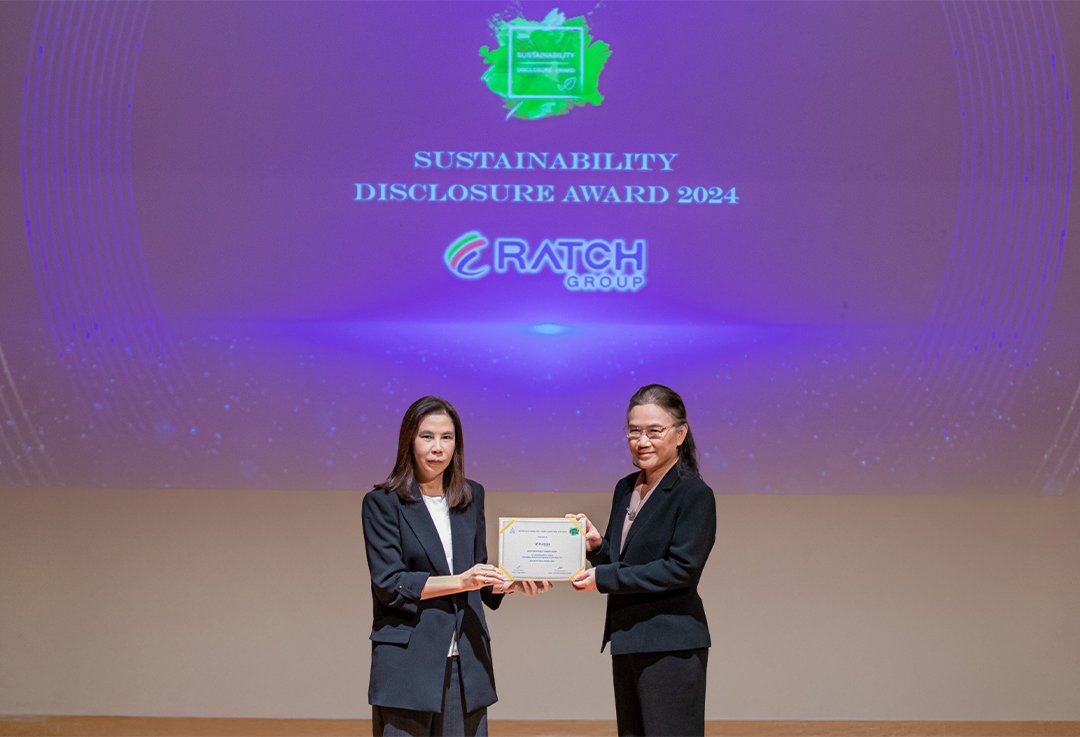
RATCH is bestowed the Honorary Sustainability Disclosure Award 2024 from Thaipat Institute, the sixth year in a row, thanks to the public disclosure of sustainability information in line with Ceres-ACCA criteria in terms of completeness, credibility and communication.