



Nature of business
RATCH Group PCL. operates as a holding company that focuses primarily on electricity generation and energy businesses. At present, RATCH has invested in fossil-fuel and renewable power plants and a battery energy storage business in Thailand, ASEAN, and Australia, to strengthen Thailand’s electricity security and the transition to low-carbon energy for long-term value creation. RATCH has also invested in electricity-related businesses involving, for example, maintenance and operation services, fuel supply, and energy innovation, as well as infrastructure-related businesses like electric trains, hospitals and tap water that support national economic and social development.
Investment
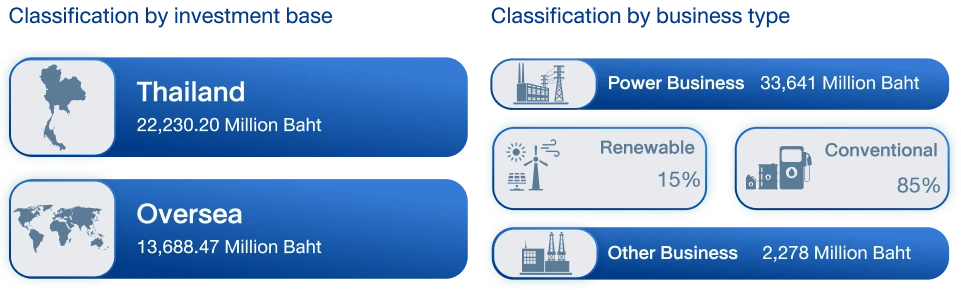
As of 31 December 2025, RATCH held shares, directly and indirectly, in 75 subsidiaries and joint ventures.
| Investment | Level of residual risk: Low | No. of non-power businesses | ||
|---|---|---|---|---|
| Thailand | Abroad | Thailand | Abroad | |
| 30 subsidiaries (shareholding above 50%) |
13 | 15 | 2 | 1 |
| 45 joint ventures (shareholding below) |
15 | 12 | 14 | 4 |
| Total | 28 | 26 | 16 | 5 |
To ensure the effective governance of subsidiaries, affiliates, and joint venture companies in compliance with applicable laws and the Company’s policies, RATCH reviewed and implemented the Regulation on the Supervision of Subsidiaries, Affiliates, and Joint Venture Companies in 2025. The regulation serves as a governance framework for overseeing the Group’s companies, promoting operational efficiency and supporting the achievement of the Company’s objectives and strategic goals.
For further information, please refer to the RATCH Group Public Company Limited’s Regulation on the Supervision of Subsidiaries, Affiliates, and Joint Venture Companies.
Business activities and value chain
Revenue structure
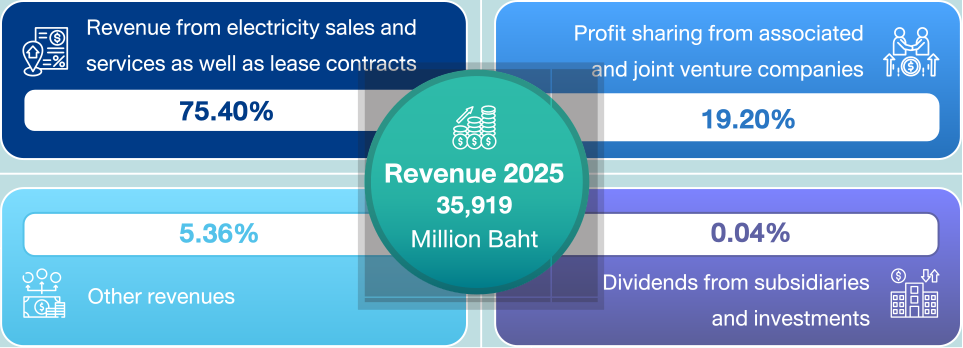
RATCH’s revenue can be categorized into four main sources: (1) revenue from electricity sales, services, and lease contracts; (2) profit sharing from associates and joint ventures; (3) dividends from subsidiaries and investments; and (4) other revenues.
Revenue from electricity sales, services, and lease contracts is the Company’s primary source of revenue, generated from its electricity business in accordance with relevant agreements and market structures in each country. This includes availability payments, energy payments, capacity payments, fuel-saving incentives, and sales of electricity and steam to industrial users. Profit sharing is derived from investments in associates and joint ventures, while dividend income is received from subsidiaries and other investments. Other revenues comprise interest income, management fees, and miscellaneous income.
2025 Revenue
Classification by revenue structure