Stakeholder Engagement Guideline

Realizing that business success needs collaboration from all relevant parties, RATCH is determined to treat all stakeholders in an equal manner, balance the shared value and promote mutual growth throughout the value chain. The company also emphasizes stakeholder engagement as a mechanism to understand the impacts, expectations  and issues concerning the organization’s business operations and sustainability and stakeholder engagement is integrated into the governance and operational structureand holds the Code of Conduct as a key guiding principle of the company.

More Info:

Stakeholder Engagement Guideline
Treatment of Shareholders
  1. The Company is committed to conducting business to achieve continuous growth and profitability ensuring favorable returns for shareholders as well as creating added value for the business, which will contribute to long-term shareholder returns.
  2. The Company conducts its business with prudence, integrity, and fairness, ensuring equitable treatment of all shareholders while prioritizing the best interests of shareholders as a whole.
  3. The Company respects shareholders’ rights to access essential information for assessing its management performance. It ensures equal and comprehensive disclosure of financial performance, financial position, and other relevant reports-both financial and non-financial. Additionally, the Company provides information on future business prospects based on realistic assessments, supporting data, and reasonable justifications, ensuring regular, complete, and accurate disclosures in accordance with internationally accepted standards for domestic and international financial and capital markets.
  4. The Company has a policy to record accounting transactions accurately, completely, in accordance with accounting standards and related laws through review by internal auditors, the Audit Committee and certification by independent auditors of the Company.
  5. All executives and employees devote their knowledge and abilities and apply their knowledge and skills to manage and operate to the best of their ability.
  6. The Company shall collect and maintain shareholders’ personal data in strict confidentiality and will not disclose or share such information in any form with unauthorized parties.
Treatment of Employees
  1. The Company strictly complies with all applicable laws and regulations related to labor or employees.
  2. The Company treats employees with respect for individuality and human dignity.
  3. The Company avoids any unfair practices that may impact employees’ job security, as well as any actions that may harass, intimidate, or create psychological pressure on employees.
  4. The Company provides fair compensation and benefits benchmarked against leading companies.
  5. The Company conducts appointments, transfers, rewards, and disciplinary actions with equity, integrity, and fairness, based on employees’ competence and suitability for their roles.
  6. The Company places great importance on managing and developing employees to ensure comprehensive and continuous enhancement of their knowledge and skills.
  7. The Company provides a safe working environment in accordance with occupational health and safety standards, supporting both efficient performance and employees’ well-being.
  8. The Company encourages employees to participate in various activities and to express their opinions, feedback, and suggestions based on integrity and professional knowledge.
  9. The Company provides a formal channel for employees to file complaints in cases of unfair treatment, following the established procedures and processes.
  10. The Company shall maintain the confidentiality of employees’ personal data and will not disclose or share such information in any form with unauthorized parties.
Treatment of Customers
  1. The Company is committed to produce and deliver high-quality products and services on schedule while continuously improving production efficiency with an aim to create environmentally friendly products and uphold product responsibility.
  2. All executives and employees must maintain customer confidentiality and do not misuse customer secret for personal gain or for benefit of related parties.
  3. The Company discloses information about products and services completely, accurately, and without distorting the facts.
  4. The Company adheres to agreements made with customers, including honoring product and service warranties under the agreed-upon terms. In cases where the Company is unable to fulfill its commitments, it shall promptly notify the customer to jointly determine an appropriate solution.
  5. The Company has established systems and processes that allow customers to communicate and/or submit complaints regarding products and services. The Company also operates at its best to ensure prompt customer responses.
  6. All executives and employees must not solicit, accept or offer any improper benefits in trading with customers.
  7. The Company is committed to developing and maintaining a good and sustainable relationship and mutual trust with customers. It shall ensure the confidentiality of customer information, including personal data, and will not disclose or share such information in any form with unauthorized parties.
Treatment of Creditors
  1. The Company honors all agreements with its creditors, including financial institutions, bondholders, and business creditors, and treats all creditors equally, with integrity, transparency, and fairness.
  2. The Company strictly complies with agreed-upon terms with creditors, including the intended use of proceeds, repayment of principal and interest, and the maintenance of collateral quality throughout the contract period.
  3. All executives and employees must not solicit, accept, or offer any improper benefits in negotiations with the Company’s creditors.
  4. The Company is committed to actively cooperating in resolving issues related to the solicitation, acceptance, or offering of any improper benefits in its dealings with creditors.
  5. The Company shall accurately, completely, and timely report financial information and compliance with contractual terms to its creditors on a regular basis.
  6. In the event that the Company is unable to comply with any contractual terms or faces circumstances that may lead to a default, it must promptly notify the creditor to jointly seek a reasonable and appropriate solution.
  7. The Company shall maintain the confidentiality of creditors’ information, including personal data, and will not disclose or share such information in any form with unauthorized parties.
Treatment of Trading Partners/Suppliers
  1. All executives and employees adhere to the best interests of the Company, regardless of their own interests or those of their associates.
  2. The Company provides equal opportunities to trading partners/suppliers in trade competition, both small businesses and businesses belonging to the underprivileged, minorities, women, and disabled veterans.
  3. Establish a transparent and fair competitive bidding and selection process for trading partners and suppliers.
  4. Prepare standard contracts in accordance with legal principles and/or internationally accepted practices, ensuring mutual agreement between both parties.
  5. The Company complies with agreed-upon terms with trading partners and suppliers, including clearly communicating payment terms in writing, maintaining collateral as required, and returning it as agreed.
  6. Establish assessment and management system of supplier risks, along with a monitoring process to ensure compliance with the Company’s Supplier Code of Conduct, personal data protection policies, corporate governance standards, and contractual obligations throughout the engagement.
  7. Ensure that safety, occupational health, and a suitable working environment are maintained for suppliers operating within the Company’s premises.
  8. Promote and support suppliers in conducting their operations based on good governance, human rights, and sustainable development principles, while fostering long-term collaboration and strong business relationships.
  9. All executives and employees must strictly follow the Company’s conditions committed with suppliers under fair and transparent framework.
  10. All executives and employees must not solicit, accept, or offer any improper benefits in business dealings with the Company’s suppliers. Additionally, the Company shall provide a complaint channel for suppliers to report any concerns.
  11. In the event that the Company is unable to meet its contractual obligations, it shall promptly notify the supplier in advance to jointly seek an appropriate solution.
  12. The Company shall maintain the confidentiality of suppliers’ information, including personal data, and will not disclose or share such information in any form with unauthorized parties.
Treatment of Business Competitors
  1. The Company respects and strictly complies with the principles of fair-trade competition laws or national antitrust and international principles.
  2. The Company treats business competitors in accordance with fair competition principles and internationally recognized trade competition standards.
  3. All executives and employees must not seek competitors’ information through dishonest or inappropriate means.
  4. All executives and employees must not make false or baseless accusations against business competitors.
  5. All executives and employees must not solicit, accept, or offer any improper benefits in business dealings with the Company’s competitors.
  6. All executives and employees must strictly comply with the terms and regulations of fair-trade competition.
Treatment of Business Partners
  1. All executives and employees are committed to strictly complying with the agreements and commitments made with business partners.
  2. Provide business assistance in a mutually beneficial manner for the overall business outcome, taking into account the best interests of the Company and based on fair returns to both parties.
  3. All executives and employees must provide truthful information, accurate reports, and engage in problem-solving and negotiations based on legitimate business relationships.
  4. The Company shall maintain the confidentiality of business partners’ information, including personal data, and will not disclose or share such information in any form with unauthorized parties.
Treatment of Public Sector
  1. The Company respects and strictly complies with all laws, regulations, and government requirements governing its business operations in each locality and country.
  2. The Company supports government operations and ensures the preparation and reporting of accurate information to relevant regulatory authorities in compliance with legal requirements.
  3. The Company promotes collaboration with government agencies to support national strategies and objectives, contributing to economic, social, and community stability and growth on a broader scale.
Treatment of Community, Society and Environment
  1. The Company is committed to conducting business with responsibility toward communities, society and the environment by integrating them in the Company’s mission. This approach aims to earn recognition and trust from communities and society, leading to business success as well as sustainable development and growth of the business.
  2. The Company respects the rights of local communities, including their customs, traditions, culture, and way of life, and actively promotes, supports and preserve them for long-term sustainability.
  3. Conduct risk assessments for business operations and/or projects that may impact community health, safety, and the environment. Implement preventive, corrective, and mitigation measures with maximum effectiveness throughout the investment feasibility study, operational phase, and decommissioning process.
  4. Foster community engagement and participation from all relevant stakeholders to collaboratively enhance quality of life and create sustainable value for local communities and society. The Company shall also support and assist surrounding communities and the broader society at both local and national levels as appropriate.
  5. The Company supports the development of projects and activities, both independently and in partnership with external organizations, that are appropriate and beneficial to communities and society. These initiatives shall be aligned with the Company’s strategic goals and responsive to stakeholder expectations.
  6. Establish appropriate dialogue processes to enable community and stakeholder participation in exchanging opinions, collaboratively solving problems, monitoring the Company’s operations and/or projects, and serving as a channel for community grievances and concerns.
  7. Operate with maximum efficiency in the use of natural resources, while considering alternatives that minimize impacts on climate change, communities, and society.
  8. Implement control and management measures to ensure that the environmental impact of operations remains within legal requirements and/or industry standards.
  9. Develop/ implement internationally recognized environmental management systems to assess environmental risks and impacts, while ensuring compliance with environmental laws and regulations.
  10. Promote the use of renewable energy, energy and water conservation, waste reduction and management, as well as the restoration and preservation of forests and biodiversity within ecosystems to reduce greenhouse gas emissions and ensure long-term benefits for future generations.
  11. Encourage executives and employees to develop awareness and a strong sense of responsibility toward society and the environment.
  12. Cooperate with relevant organizations in implementing international standards and agreements aimed at preventing or mitigating social and environmental impacts.
  13. Collaborate with relevant organizations to reduce waste generation from both production processes and general operations, ensuring proper and appropriate waste disposal methods.

Key Stakeholders

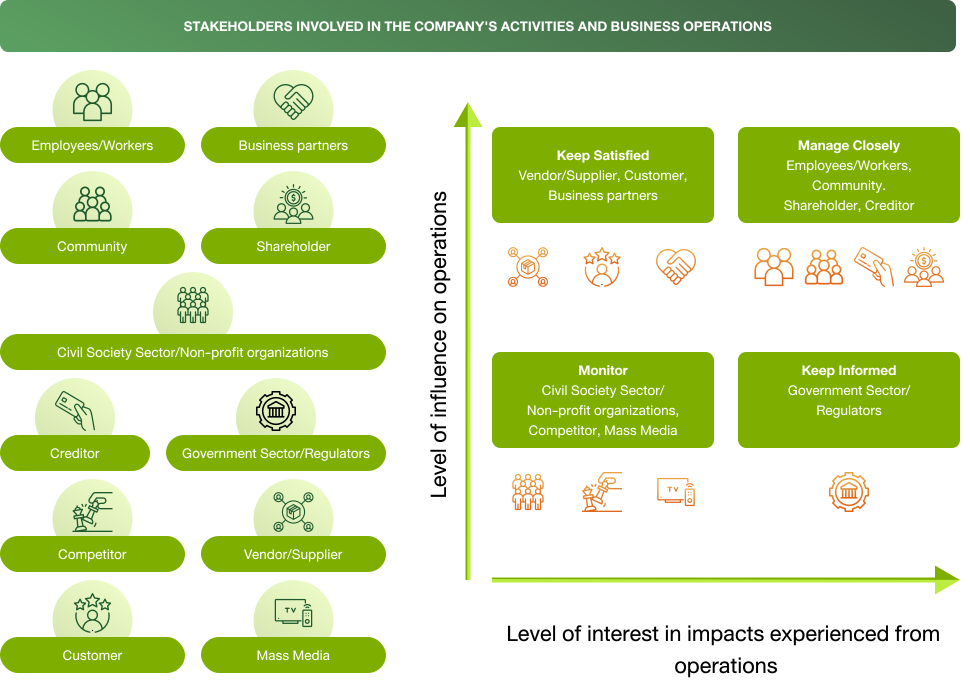
RATCH identifies key stakeholders by considering their influence on business operations, the level of impacts that the organization has on stakeholders, and their relevance to the business operations. RATCH has 11 key stakeholder groups.

imgTitle

Guide to Stakeholder Engagement

Issues of concern Response guidelines
Employees/Workers
Appropriate compensation and welfare in line with economic conditions
  • Review employee remuneration/welfare to be in line with current circumstances/peer companies, adhering to equal employment, human rights principles and regulatory requirements.
  • Provide a fair performance evaluation system and engage employees in self-evaluation, to fairly reflect their remuneration.
Safe and favorable work environment
  • Inspect/improve work environment for safety and comfortable conditions conducive to positive impacts on the operations.
  • Appoint employee representatives to the Welfare Committee and the Safety, Occupational Health and Working Environment Committee.
Capability development and career advancement
  • Prepare training/career development programs for individual employees and the Succession Plan.
  • Set a rotation policy for skills and experience in various fields.
  • Prepare the Succession Plan based on the results of potential assessment.
  • Prepare individual development plans based on skills, potentials, experience and business needs.
  • Encourage and promote team-oriented activities and innovation, to strengthen corporate culture and engagement.
Fair and equal treatment and retention of employee personal information
  • Enforce the Human Rights Policy that encompasses the operations of the Company, subsidiaries and joint ventures and communicate the policy to all relevant personnel for their strict compliance.
  • Enforce the Personal Data Protection Policy, to prevents the impacts on employees from data breaches.
  • Establish a complaint and feedback system/channel and notify employees through communication channels.
Community
Operations that underline legal compliance, transparency, and effective measures to prevent/ respond to impacts
  • Strictly comply with relevant legislation and establish compliance units that monitor the operations in accordance with laws such as a legal department and a governance working committee.
  • Follow environmental and social impact preventive and corrective measures.
  • Require the monitoring of operations that may cause impacts on the environment and community.
  • Apply production technology and control the production in line with requirements, to lessen environmental impacts on community/society.
  • Establish thorough and various complaint/feedback channels as well as a systematic handling process.
  • Exercise the emergency response plans together with community for their confidence in the Company's solutions and responses to emergency incidents.
Transparent, timely, and verifiable communication and information disclosure
  • Apply two-way thorough communications with community/society through various channels like social media, notifications, community visits and community development activities.
  • Build engagement through the establishment of special committees such as the Environmental Inspectors Committee/Tri-Partite Committee that act as the intermediary in the inspection of power plants' operations; and enhancement of the committees' capacity.
  • Prepare accurate and continuous communication materials and establish a special responsible unit such as the public relations department and a community relations team.
  • Communicate information and open doors to community visits to the operating sites, for their understanding and confidence in the production process and the environmental and safety management.
Promotion and quality of life improvement for community and society
  • Prepare the plans to improve community quality of life to suit community needs in various aspects - career, education, public heath, tradition and culture, etc.
  • Support and participate in community activities on a regular basis.
Timely responses to community troubles
  • Establish channels to hear community suggestions/complaints in the environmental, occupational health and safety management systems of each business entity/Environmental and Social Management System for the consideration of inspection and correction.
  • Define the roles, duties and responsibilities of the complaint handling committee in a clear, transparent and verifiable manner and require regular performance reports.
Civil society sector/Non-profit organizations
Business operations that support the goals of these organizations/ networks as well as national sustainability goals.
  • Support the organizations/networks' goals with continuous operations at full potential.
  • Participate as a member of associations/organizations.
  • Renew the membership continuously.
  • Monitor the networks/organizations' updates for business operations that are up to date with the situation.
Disclosure of accurate and verifiable information
  • Prepare and verify information prior to disclosure.
  • Release accurate and timely public relations materials.
Participation in impact/ performance inspection
  • Provide opportunities for study tours or engage them in correcting impacts.
  • Establish a working committee/environmental inspectors committee/tri-partite committee that engages all parties.
Government sector/Regulators
Compliance with legislation, rules and regulations enforced in Thailand and abroad
  • Establish a system and unit to monitor amendments in relevant laws/regulations in Thailand and abroad; assess compliance on a regular basis; and report progress for the Management and the Board of Directors’ acknowledgement.
  • File complete reports and disclose compliance reports as required by relevant laws and regulations.
Good corporate governance and transparency
  • Define the comprehensive and appropriate governance structures and supervisory roles and duties of all operational aspects.
  • Seek CAC’s continuous membership recertification.
  • Encourage and support subsidiaries, affiliates and joint ventures as well as suppliers in the supply chain to join CAC and serve as CAC Change Agents.
  • Prepare the environmental, safety, and other relevant management systems to ensure legal compliance.
Organizational ability to cooperate and support the government sector/ government offices’ policies Cooperate with regulatory agencies’ sustainability-related activities, voluntary and compulsory, to elevate the organization’s sustainability operations.
Strengthen national energy security Provide the best support and cooperation in maintaining the national electricity stability and efficiency.
Vendors/Suppliers
Professionalism and honest and ethical partnership
  • Define desirable practices in the Supplier Code of Conduct and demand acknowledgement for aligned practices and mutual goals.
  • Prepare a fair agreement and mutually-agreed payment conditions, and strictly follow the conditions.
  • Ensure safe work conditions for suppliers in line with prescribed standards particularly high-risk jobs.
Transparent operations and zero violation to human rights
  • Develop a transparent supplier selection and procurement process that prevents conflict of interest and involves the assessment of their ESG and human rights risks.
  • Deal with supplier complaints on actions that do not meet contractual requirements or are unfair.
Compliance with contracts Establish a contract management system and a process to monitor suppliers' operations; and control budgets.
Improvement of suppliers' operations
  • Monitor and evaluate suppliers' operations and performance for further improvement.
  • Arrange training/orientation prior to the start of work; conditions for work request or permit; job inspection/supervision; and performance evaluation.
Customer
On-time delivery of products and services that meet specified requirements on quality, volume and stability; do not create impacts on the environment, community and society; and emits a low amount of greenhouse gases.
  • Operate strictly in accordance with the operation and maintenance schedule to maintain efficiency and availability, for prompt and efficient response to customers' requests and the electricity system stability.
  • Prepare the cybersecurity and supervision system.
Operations with good corporate governance and zero environmental impacts Operate and manage contracts transparently and in accordance with the terms and conditions agreed upon with customers/consumers.
Cooperation in problem solving and relationship building
  • Jointly discuss the terms or disputes.
  • Organize consistent meetings and relationship-building activities.
Safeguarding of confidentiality and personal information Define the terms and conditions and honor them.
Business partners
Business stability with consistent stream of revenue and profits; good corporate image; corporate governance; efficiency; and long-term sustainable growth
  • Prepare a partnership strategy that strengthens the Company's competitiveness and growth potential in power and related businesses.
  • Clearly state the Company's position on business practices that adhere to morality, ethics, legal compliance, anti-corruption, and respect for human rights.
Professionalism and operational efficiency for long-term partnership
  • Prepare a partner due diligence and risk-assessment process prior to striking partnership deals.
  • Honor the agreements, confidentiality clauses, and fair competition laws.
  • Ensure transparent governance and nurture relations for long-term partnership.
  • Apply the arm's length principle for fairness and provide accurate and sufficient information for the decision making.
  • Develop personnel's knowledge and skills and promote the corporate values that underline teamwork, innovation, professionalism and leadership competency.
Shareholders
Ability to execute strategies and generate good returns
  • Ability to achieve positive performance and returns
  • Board of Directors and the Management’s close monitoring of the operations and performance tracking against set targets.
  • Development of personnel capabilities to support professional operations.
Good corporate governance and ability to manage ESG risks and execute the sustainability strategy as planned
  • Board of Directors’ governance practices
  • Alignment of operations with business and sustainability strategies as well as operational targets.
  • Ability to manage environmental, social and governance (ESG) risks and execute the sustainability strategy.
Adaptability to transitions and emerging risks
  • Monitoring and adaptation to technological changes and emerging risks.
  • Development of employee knowledge and skills to accommodate new business opportunities and strengthen business resilience.
Efficiency in inspecting/ preventing fraud and corruption
  • Assess fraud risks and establish measures to inspect and prevent all forms of fraud and corruption.
  • Determine a responsible unit and a clear mechanism of its responsibility for inspection and supervision, to prevent fraud and corruption in the operations.
Creditors
Ability to generate revenue and profits and to repay debts, with reliable credit ratings and business growth
  • Ensure the operations and information disclosure in accordance with the terms and conditions.
  • Determine the clear management approach/plan for revenue, cost and returns.
  • Establish the clear EBITDA growth target and the management plans for revenue, cost and returns.
  • Maintain the corporate credit ratings at an investment grade.
  • Strictly follow the agreed terms, concerning the purposes of fund, principal and interest repayments, and the maintenance of collateral quality throughout the contract period.
Investment and funding approach/plans for project financing
  • Conduct revenue analysis and forecasting and manage financial risks.
  • Choose low-cost funds and financial tools that match each type of project.
Ability to keep financial risks at low or acceptable levels
  • Strictly follow the Company's financial and tax policies. at low or acceptable levels
  • Ensure efficient financial management including financial costs.
Continuity in good relationship Communicate, exchange information and promptly seek solutions on a mutual basis.
Corporate credibility, reputation and governance
  • Establish the guidelines for ESG (Environmental, Social and Governance) risk management and the sustainability strategy execution.
  • Participate in sustainability/ESG ratings by international agencies.
  • Improve the implementation of operational plans according to rating agencies' recommendations.
Support to national and global sustainability/climate change goals
  • Drive a recognized climate-related strategy and the human rights implementation.
  • Set the goal to achieve net zero emissions in 2050.
  • Report the performance of climate actions and volume of greenhouse gas emissions.
Competitors
Fair competition
  • Comply with competition laws and the Company's Code of Conduct.
  • Avoid any action that may be considered a collusion to distort competition.
  • Do not accept information from competitors, directly or indirectly, or exchange/receive illegal information for benefits in the competition.
Mass Media
Accurate, timely, transparent and equal information disclosure
  • Disclose information as required by relevant laws and regulatory agencies.
  • Establish a process to verify information prior to public disclosure or the release to media.
  • Require Chief Executive Officer’s approval for financial and non-financial information to be released to journalists.
  • Establish guidelines on the use of internal information.
Two-way communications and continuous relationship building
  • Arrange press events as deemed appropriate, one-way or two-way communication patterns, ensuring equitable, timely, accurate, and adequate disclosure.
  • Establish a process to take and answer questions or to pass information to the media.
  • Organize consistent relationship-building activities.
  • Monitor news updates on a regular basis.
\