




Human Rights Due Diligence Process
The Company Group’s operations involve employees, suppliers and neighboring communities, which may result in direct and indirect impacts on human rights. Therefore, human rights have been identified as a material issue and are integrated into the enterprise risk management and sustainability practices.
Impact Boundary
| Boundary | Rights-holders |
|---|---|
| Internal boundary | Full-time employees, contract employees, probationary employees |
| Value chain | Suppliers, contractors, raw material suppliers |
| External boundary | Community in operational areas, customers, related rightsholders |
Impact, Risk and Opportunity
| Possible negative impact | Enterprise risk | Opportunity |
|---|---|---|
|
|
|
Assessment of Human Rights Risks and Impacts
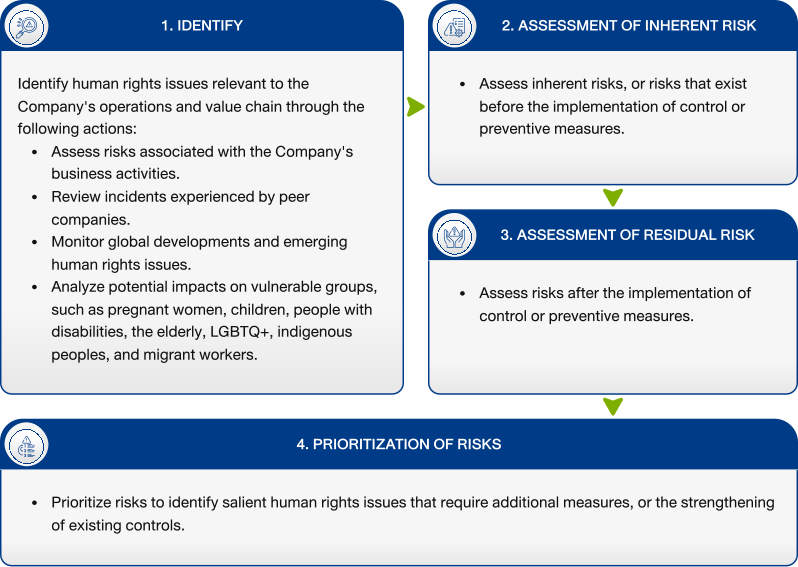
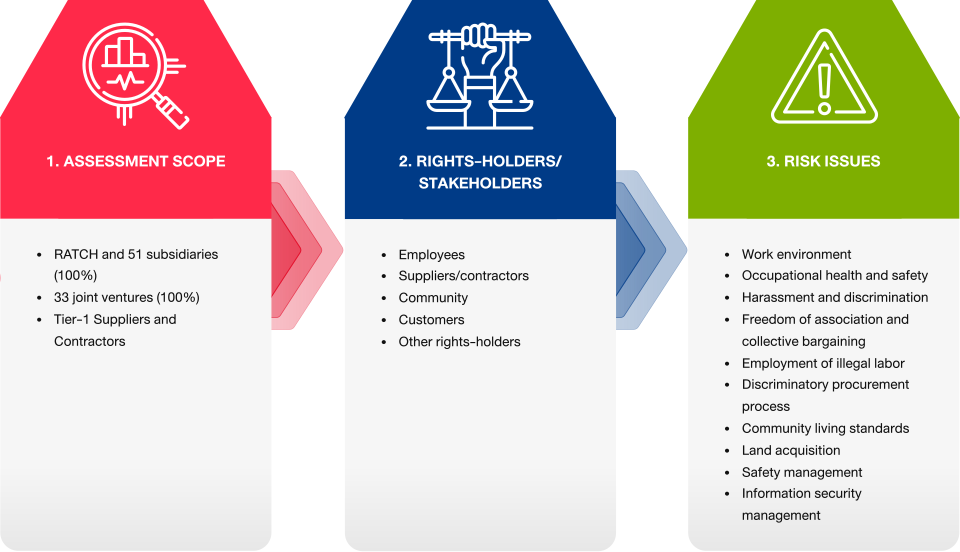
RATCH conducted a Human Rights Due Diligence in 2025 in accordance with the three-year review plan to evaluate the appropriateness and completeness of the Human Rights Risk Register, as well as the effectiveness of prevention, mitigation, and remediation measures. The due diligence process followed the UN Guiding Principles on Business and Human Rights (UNGPs) and covered the Company, its subsidiaries, joint ventures and Tier-1 suppliers.
Human rights risks and impacts assessment procedures
Scope of human rights risk assessment
Results of human rights risk assessment and management measures
More Info:
| Risk issue: Supplier/contractor’s occupational health and safety |
|---|
|
Management measures
|
| Risk issue: Community living standards |
|---|
|
Management measures
|
| Risk issue: Land acquisition and community relocation |
|---|
|
Management measures
|
| Risk issue: Information safety management for all rights holders |
|---|
|
Management measures
|
| Risk issue: Treatments of suppliers’ workers |
|---|
|
Management measures
|
| Risk issue: Occupational health and safety |
|---|
|
Management measures
|
Employee-related Human Rights Impact Assessment
In 2023, RATCH conducted the employee-related human rights impact assessment, to affirm the 2022 risk assessment results. The activity in 2023 entailed the employees of the Company and operational controlled entities as they are considered the most important internal rights-holders. It served as a review of the latest assessment of impacts on employees and the evaluation of the efficiency of current actions and preventive measures.
The assessment was conducted through an opinion survey involving employees in all business functions working in Thailand and abroad.
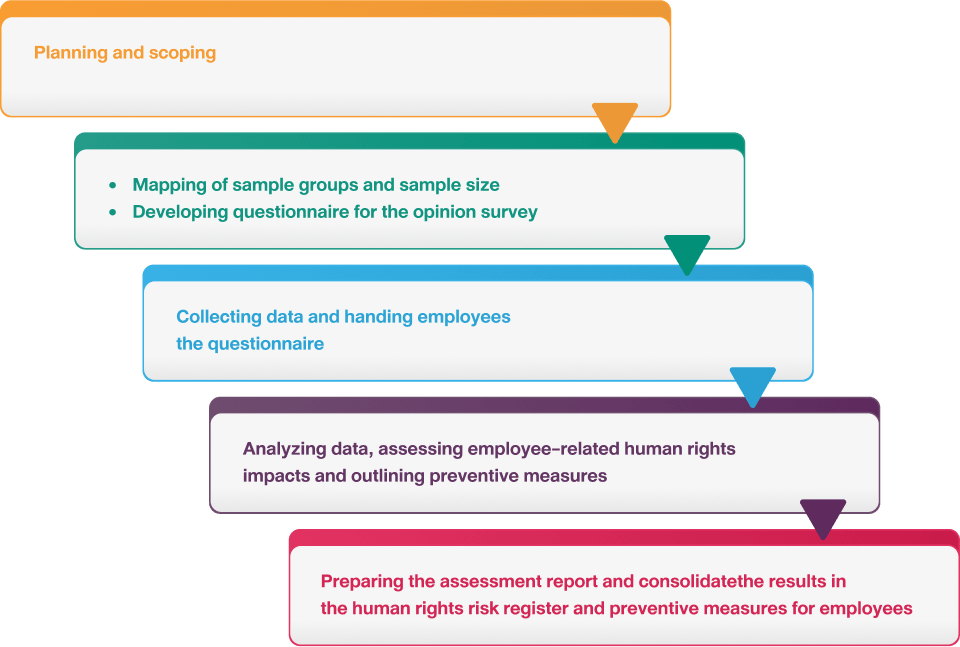
Scope of Employee-related Human Rights Impact Assessment
Mapping of sample groups: The sample groups involved the employees of RATCH and operational controlled entities, separated into 5 groups according to the nature of their business units' operations. Such as fossil fuel power plants, renewable power plant, infrastructure, electricity-related and energy and head office. The sample size was based on a scientific method, to achieve an appropriate number of samples and complete representation of each business group. There were 645 respondents in total.
Scope of the survey: Involving employees working in Thailand, Lao PDR, Vietnam, Indonesia, Singapore and Australia.
Scope of the assessment: The issues covered in the assessment were based on the Company’s human rights issues gathered in 2022 and extended to cover the risks in international contexts and of other leading companies. The human rights aspects covered in the assessment are as follows:
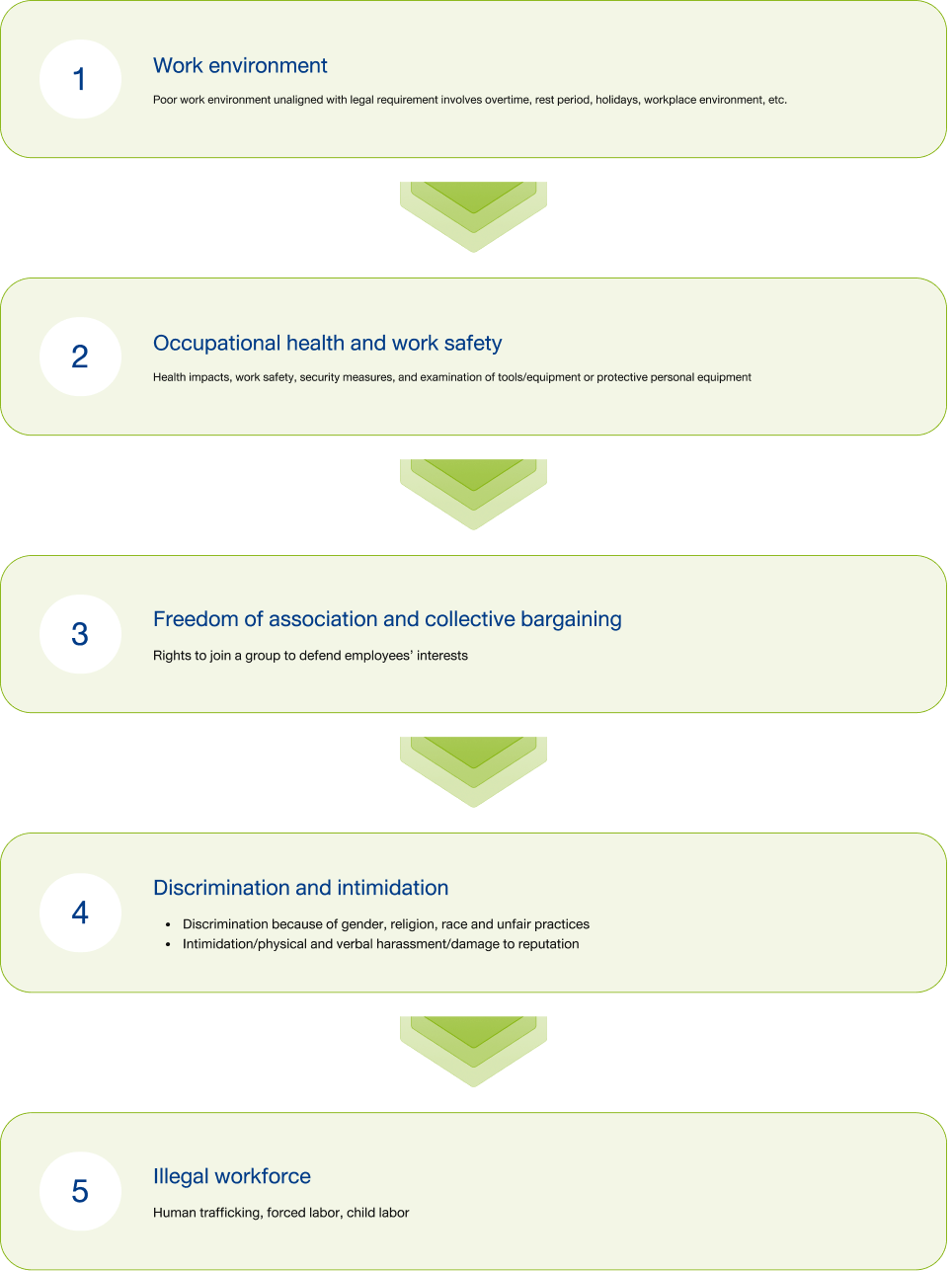
Summary of Employee-related Human Rights Risk Assessment Results
| Work environment | Low |
| Occupational health and work safety | Low |
| Freedom of association and collective bargaining | Low |
| Discrimination and intimidation | Low |
| Illegal workforce | Low |
The assessment of human rights risks on the employees of RATCH and controlled business entities in 2023 showed the low level of risks in all aspects; work environment, occupational health and work safety, freedom of association and collective bargaining, discrimination and intimidation, and illegal workforce. Nevertheless, RATCH took employees’ recommendations into consideration and outlined additional actions aside from the prescribed prevention and control measures. The actions implemented in 2024 are summarized below:
| Recommendations | Continuous communications on the Human Rights Policy and guidelines through communication channels for employees’ engagement in the prevention of internal violation |
| Action in 2024 |
|
| Recommendations | Inspection of work condition; and review of pay, compensation and welfare for more fairness and suitability to each employee’s job description/performance as well as continuous increases in the cost of living |
| Action in 2024 |
|
| Recommendations | Safety culture for employees’ awareness and strict compliance with the Company’s safety and occupational health policy as well as safety measures |
| Action in 2024 |
|
| Recommendations | Non-discriminatory treatment, fight against harassment, the diversity policy, the communications of complaint channels to all employees and assurance of complainant protection and fair investigation/correction of complaints |
| Action in 2024 |
|
| Recommendations | Protection of employees from the repercussions of exercising their freedom of association and collective bargaining and from employment of illegal labor |
| Action in 2024 |
|
| Additional measures to employee-related human rights risks |
|---|
|
Building awareness and consultation on human rights
The Company has continuously raised awareness of human rights, to ensure that the Company’s employees, subsidiaries, and joint venture companies are aware of the importance and respect the human rights and human dignity of all rights holders. The Company has also consulted with representatives of the Group’s businesses on guidelines for promoting human rights and ways to prevent possible human rights violations within the organization. In 2025, the Company launched communication activities to cultivate understanding in the Human Rights Policy and learnt about the Company Group’s management measures related to human rights issues. Details are as follows:
| Communication/ Consultation activity | Communication/ Consultation issue | Improvement/ Implementation guidelines |
|---|---|---|
| Training titled “Human Rights” | ||
|
|
|
| Human Rights Communication to the Group of Companies | ||
|
|
|
Remediation
RATCH is committed to continuously conducting human rights risk assessment whilst preparing risk mitigation and prevention measures, monitoring and reporting of performance to ensure effectiveness of its human rights management. The Group also continues to review policy commitments as well as addressing any complaints and providing effective remedy in case of violation, to relevant affected rights holders.
In case of human rights violations or adverse human rights impacts caused by RATCH’s activities, the Group will take remediation actions, which may involve compensations and other forms of remedy including: apologies, restitution, rehabilitation, financial or non-financial compensation, and repetitive prevention measures.
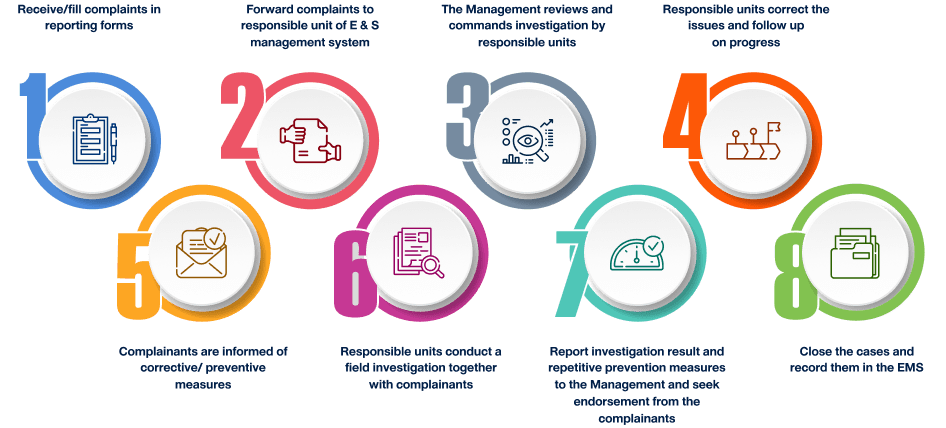
RATCH’s Complaint-receiving channel and issue-solving procedure is outlined below