




Climate Change Management
Climate change is a key issue affecting the power and energy sector in such areas as business continuity energy security, operating cost, and stakeholder expectations. Well aware of this, the Company places importance on the management of climate risks and opportunities in both the group level and the project level, to ensure long-term business growth and sustainable value creation.
Management Guidelines
RATCH has devised group-level guidelines for climate change management, focusing on the mitigation of environmental impacts and strengthening of operational continuity through the integration of climate change into the organizational strategy, risk management and governance of subsidiaries. Key guidelines are as follows

- Raising the proportion of renewable and low-carbon energy
- Encouraging subsidiary-managed power plants to enhance their efficiency in order to reduce the demand for energy, water and other resources in the generating process
- Promoting energy conservation and continuous monitoring of energy consumption and greenhouse gas emissions from operations
- Preparing the Group's GHG registry covering Scope 1-3 emissions and calculating carbon footprints based on Thailand Greenhouse Gas Management Organization (Public Organization)'s Carbon Footprint for Organization tool, for the formulation of GHG-reduction strategy and targets, in quantity and intensity terms, firstly for Scope 1-2 emissions
- Upgrading measures to monitor the environmental impacts of power plants in the investment portfolio through the Environmental and Social Management System (ESMS) mechanism
- Encouraging subsidiaries to adopt artificial intelligence in enhancing the power plant operation and maintenance efficiency in a proactive manner

- Supporting subsidiaries in assessing potential physical risks from climate change – extreme weather, drought, flooding and wildfire – that may affect the operations and generation activities
- Using the assessment results in designing the operational plan, preventive measures, a response plan and the business continuity plan
- Carrying out the assessment of climate change risks in the project-level environmental impact analysis and designing projects according to the results along with preventive measures The assessment results have been used to outline proactive management measures with clear short to medium-term operational targets (less than 10 years), such as the construction of a supplementary reservoir and connecting of the water network to prevent and mitigate water shortage; the installation of flood barriers and elevation of the operating ground to deal with flooding; etc.

- Considering greenhouse gas emissions and transition risks as part of the project assessment criteria.
- Adopting the Internal Carbon Pricing concept as a tool for the Company Group's analysis and evaluation of investment projects as well as asset management, by considering the hypothetical carbon cost along with technical, economic, and environmental factors to reflect the risks of the transition to a low-carbon economy.
- Driving investments that reduce environmental impacts which are aligned with the Company's strategy to support the energy transition.
Governance of Climate Change Management
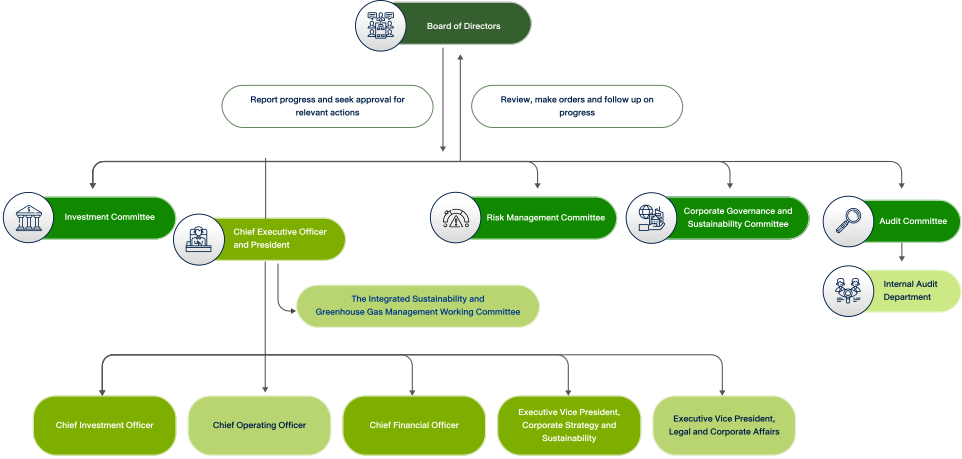
| Organizational body | Role and responsibility concerning climate change |
|---|---|
| Board of Directors |
|
| Risk Management Committee |
|
| Corporate Governance and Sustainability Committee |
|
| Investment Committee |
|
| Audit Committee |
|
| Chief Executive Officer and President |
|
| Chief Investment Officer |
|
| Chief Operating Officer |
|
| Chief Financial Officer |
|
| Executive Vice President, Corporate Strategy and Sustainability |
|
| Executive Vice President, Legal and Corporate Affairs |
|
| Internal Audit Department |
|
| The Integrated Sustainability and Greenhouse Gas Management Working Committee (The Chief Executive Officer and President serves as the Chair of the Working Committee.) |
|
Climate-Related Performance and Remuneration
To drive the tangible achievement of the Company’s greenhouse gas (GHG) emission reduction targets across the organization, the Company has directly linked the annual performance evaluations and remuneration of the Board of Directors, the Chief Executive Officer and President (CEO), all top executives, and all employees to the Corporate KPIs endorsed by the Board of Directors.
The key sustainability performance indicator utilized to assess climate change management is the Scope 1 and Scope 2 GHG Emissions Intensity, with a clearly defined target not exceeding 360 kgCO2e/MWh. The successful achievement of this climate-related target is structurally integrated into the annual performance appraisals and serves as a determining factor for the remuneration of the Board of Directors, the CEO, all top executives, and all employees. This mechanism is designed to effectively incentivize and fully align the commitment of personnel at every level with the Company’s overarching sustainability goals.
Emission reduction strategy
The Company’s emission reduction strategy is set in line with the diversified investment portfolio, as the guidelines for the management of greenhouse gases in a way that the Net Zero Emission Goal is achieved in 2050. The 4 pathways are as follows
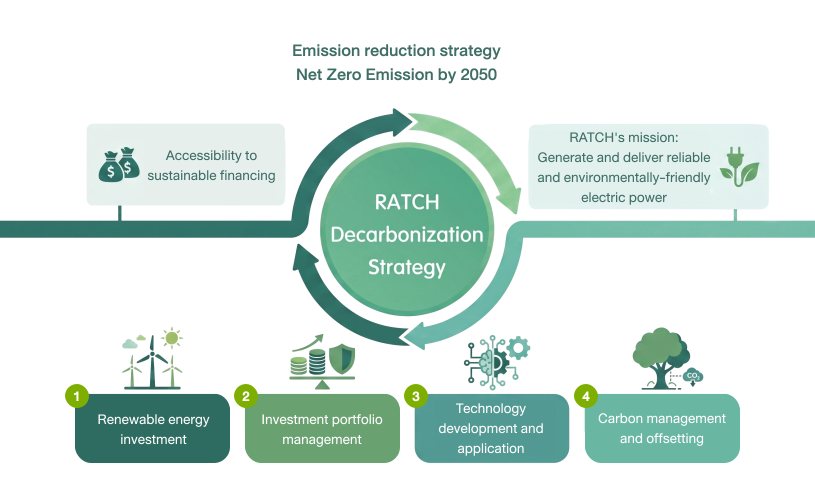
Guidelines for the management of greenhouse gases in 2025




Climate Risk Management
Climate change is a factor that will bring significant impacts on the Company’s power and energy businesses. As countries around the world are driving the energy transition with and laws being amended to achieve the net zero emission, Thailand, RATCH’s prime business base, is drafting the Climate Change legislation and relevant environmental regulations with the Nationally-Determined Contribution (NDC) 3.0 target to reduce emissions by 47% by 2035 (compared to 2019 levels) and Net Zero Emission by 2050.

Risk and opportunity management process
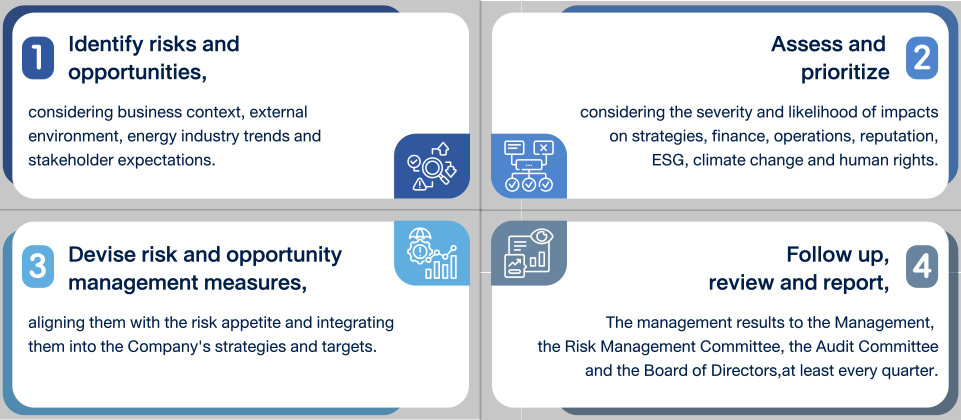
Risk and opportunity management methods and tools are tailored in accordance with the business context of a power and energy holding company. Various tools have been adopted to identify, assess and manage risks and opportunities in economic, social, environmental, technological and governance aspects, to ensure a holistic management approach and support sustainable strategic decision-making. They are summarized as follows
Climate Risk Management and Adaptation Plan

Drought
Impact period:Short to medium term
- Invest in supplementary water sources and draw an emergency water-supply plan.
- Increase proportion of power generation from renewable sources such as wind and solar power to reduce water demand and mitigate the impact of drought in the long term (from 2030 onwards).
- Ensure efficient water use in the production process by utilizing alternative water sources, improving the cooling system, and adjusting production plans to cope with long-term drought condition.
- Study 100-year rainfall statistics to assess risks for Environment Impact Assessment (EIA) preparation and project site selection.

Flooding
Impact period:Short to medium term
- Construct rainfall retention ponds and drainage system to store rainfall, manage flooding during the rainy season, and to prepare for potential drought in the future.
- Connect to the rainfall- monitoring network.
- Study rainfall records, including 100-year historical statistics and rainfall forecasts, to assess risks and potential impacts for ElA preparation and project site selection.

Extreme weather
Impact period:Long term
- Damage to infrastructure, machinery and equipment and injury due to falling objects
- Damage to the transmission grid from lightning and damage to infrastructure from hail storms.


- Operating cost rising in line with emissions from business activities
- Rising cost in the supply chain which boosts the cost of raw materials and services
- Invest in low-carbon technology/carbon storage for fossil-fuel power plants to reduce/eliminate greenhouse gases.
- Acquire renewable power plants or fossil fuel plants that are equipped with carbon capture storage technology.
- Phase out investment in coal-fired power plants.
Trade Association Partnerships for Climate Action
Membership in relevant trade associations plays a pivotal role in supporting the company’s business operations across various dimensions. These networks actively promote and enhance comprehensive sustainability across the economic, environmental, and social pillars. Furthermore, collaborating with these strategic partners fosters a deeper understanding of key industry issues, enabling the company to adopt and implement the most appropriate best practices .In 2025, the company joined leading trade associations to support policies, regulations, and guidelines aimed at addressing climate change—a critical global agenda. Specifically, the company became a member of two primary networks: the Thailand Carbon Neutral Network (TCNN) and the Thailand Business Council for Sustainable Development (TBCSD). The objective of these memberships is to leverage the company's position to co-develop best practices and establish efficient operational frameworks to effectively manage climate change and navigate emerging future challenges.
| Trade Association | Objective | Alignment with Business Operations |
Activities |
|---|---|---|---|
| Thailand Carbon Neutral Network (TCNN) | Promote collaboration among the government, private sector, and local communities to enhance greenhouse gas reduction efforts and propel Thailand towards its Net Zero goal. | Greenhouse gas emission reduction on the path towards Net zero emissions |
|
| Thailand Business Council for Sustainable Development (TBCSD) | Support and participate in environmental and climate change initiatives | Driving sustainability across all dimensions, with a particular focus on environmental and climate-related issues. |
|