




Corporate Governance Structure
| Code of Conduct: Treatment of customers |
|---|
|
More Info:
Governance
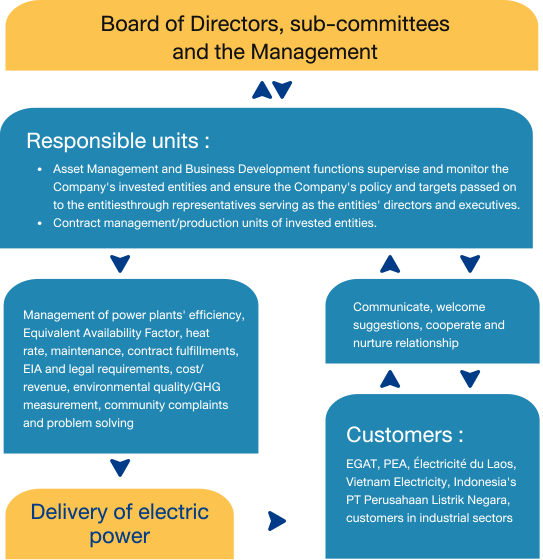
The Company has established a systematic mechanism for customer care and product responsibility, entailing the Board of Directors, the Management and responsible departments. The mechanism underlines 3 aspects which are delivery reliability, product safety and customer relationship management.
The Company has designated the reliability of electricity supply as one of the key indicators of investment portfolio management and ensured subsidiaries and joint ventures carry out the operation and maintenance in accordance with international standards and comply with the conditions of power purchase agreements and regulations in each country.
The key indicators under continuous supervision and monitoring are power plants’ availability, significant disruptions, and risks to business continuity. The information is then used to determine the guidelines on power plant efficiency improvement and risk assessment as well as correction measures.
Delivering electric power to customers
In 2025, the Company’s power plants and those under the Company’s financial control, totaling 18 in number and totaling 4,813.42 MW (and contributing 78.73% of total revenue), generated and distributed 9,729,547 MWh of electric power: 7,392,806 MWh from fossil fuels (75.98% of total distributed electric power); and 2,336,741 MWh from renewable energy (24.02% of total distributed electric power). They also produced thermal energy in the form of steam, totaling 237,033 tons, for sale to industrial customers in Thailand.
| Area | Type | Net generation (MWh) | |
|---|---|---|---|
| Total | % Equity | ||
| Thailand | Natural gas | 12,636,383 | 7,123,874 |
| Biomass | 124,945 | 64,559 | |
| Abroad (Australia/ Indonesia) |
Natural gas | 260,044 | 260,044 |
| Diesel | 8,888 | 8,888 | |
| Wind | 1,571,039 | 1,571,039 | |
| Solar | 81,023 | 81,023 | |
| Hydro | 1,294,884 | 620,120 | |
Gross Generation by Type
In 2025, the 18 power plants owned by the Company and those under its financial control achieved a total gross generation of 16,383,759 MWh; Combined Cycle Gas Turbine (CCGT) facilities were the primary energy source, representing 80% of the total generation (13,134,186 MWh). Generation from renewable energy sources consisted of Wind (1,610,440 MWh), Hydro (1,298,017 MWh), and Solar (81,588 MWh).
| Type | Units | 2025 | 2024 | 2023* |
|---|---|---|---|---|
| Gas-Turbine | Mwh | 110,419 | 196,571 | 961,110 |
| GJ | 397,508 | 707,654 | 3,459,997 | |
| Combined-Cycle Gas turbine | Mwh | 13,134,186 | 12,062,033 | 8,960,187 |
| GJ | 47,283,069 | 43,423,320 | 32,256,673 | |
| Diesel | Mwh | 8,888 | 324 | 16,170 |
| GJ | 31,997 | 1,166 | 58,212 | |
| Biomass | Mwh | 140,221 | 138,482 | 135,776 |
| GJ | 504,794 | 498,536 | 488,794 | |
| Hydro | Mwh | 1,298,017 | 1,077,569 | 1,166,141 |
| GJ | 4,672,862 | 3,879,249 | 4,198,108 | |
| Solar | Mwh | 81,588 | 79,789 | 91,083 |
| GJ | 293,717 | 287,241 | 327,899 | |
| Wind | Mwh | 1,610,440 | 1,698,657 | 1,825,152 |
| GJ | 5,797,584 | 6,115,165 | 6,570,546 | |
| Total | Mwh | 16,383,759 | 15,253,425 | 13,155,619 |
| GJ | 58,981,532 | 54,912,332 | 47,360,228 |
Remark: The 2023 data does not include the Hin Kong Power Plant, which commenced commercial operations in 2024.
Management of power purchase agreements
The 3 key indicators in this regard are:
| Availability | Reliability | Heat Rate |
|---|---|---|
| The indicator of power plants' generation capability as per the conditions specified in the purchase agreements. | The indicator of the stability of the power generation system based on the generation period and frequency of breakdowns. | The indicator of fuel utilization efficiency for the generation of power and heat. |
| Objectives | ||
| To establish preventative maintenance plans, manage spare parts, and reduce unplanned shutdowns, to ensure generation continuity and compliance with contract conditions. | To analyze the causes of failures, improve the operation process, prevent repeat failures, and maintain efficiency without unplanned outage, to ensure quality and supply continuity in line with customers' requirements and expectations. | To control operational efficiency, reduce fuel consumption and reduce environmental impacts, in support of the power plants' efficiency management and energy efficiency in accordance with contract conditions. |
| Implementation | ||
| Set target availability in line with Contracted Availability Hour (CAH) and at the level customers can accept and will not levy penalties. | Set the target number of operating hours against unplanned outage hours within the framework of PPAs. | Set annual targets for heat rate or fuel consumption per kilowatt-hour in line with contract conditions. |
Target and results
The Company Group has monitored the performance by tracking the 3 indicators – availability, reliability and heat rate – as well as complaint handling and compliance with PPAs’ terms and conditions and relevant requirements. The 3-year record reflects the Company’s ability in consistently maintaining stable supply and customer confidence.
| Targets | Indicators | 0Performance00 | ||
|---|---|---|---|---|
| 2025 | 2024 | 2023 | ||
| Maintaining the continuity and reliability of electricity supply as specified in PPAs and by power plants | Availability of each power plant | Achieve operational performance in line with the targets established by each power plant. | Achieve operational performance in line with the targets established by each power plant. | Achieve operational performance in line with the targets established by each power plant. |
| Reliability | ||||
| Heat rate | 42.86% of the power generation units maintained the heat rate in line with the established target. | 44.44% of the power generation units maintained the heat rate in line with the established target. | 57.14% of the power generation units maintained the heat rate in line with the established target. | |
| Customer satisfaction and confidence | % of customer satisfaction | 92.81 (target achieved) |
91.54 (target achieved) |
90.99 (target achieved) |
| Compliance with relevant law and requirements | Number of cases of noncompliance with penalties | 0 | 0 | 0 |
Electricity Transmission & Distribution Reliability
| Power Plant | System Average Interruption Duration Index: SAIDI (in hour) |
Transmission Loss(%) | ||
|---|---|---|---|---|
| Transmission Net Work |
Distribution Net Work |
Transmission Net Work |
Distribution Net Work |
|
| RATCH Cogeneration | 1.08 | 2.47 | 0.14 | 0.29 |
| RATCH Pathana Energy Group |
- | 12.98 | - | 3.1 |
| Nava Nakhon Electricity Generating |
10.75 | 27.98 | - | - |
| Berkprai Cogeneration | 0 | 4.67 | 0 | 0.05 |
Management of customer relationship
RATCH’s power plants prioritizes regular engagement with customers through scheduled meetings at both operational and executive levels. These sessions focus on clarifying contractual agreements, operational guidelines, and building customer confidence in our service delivery and problem-solving capabilities. We proactively communicate necessary power and steam supply interruptions, present annual operational plans, and actively listen to customer feedback. This continuous feedback loop drives ongoing process improvements, ensuring a deep understanding of customer expectations while fostering strong, long-term cooperation and relationships. The Company, through its invested cogeneration power plants in Thailand facilitate industrial customers in adopting rooftop solar solutions to enable them to generate renewable electricity for their own consumption and reduce their environmental impact.
Transparency on Timeliness for Complaint Resolution
The company is fully committed to ensuring transparency and maintaining trust with customers regarding complaint handling. The clear guidelines is established for all complaints to be addressed with due diligence, appropriate urgency, and within a predictable timeframe. Customers are kept informed of the resolution process through the following approaches.
- Categorized Handling: Complaints are categorized based on their nature and complexity. General inquiries or minor service issues are prioritized for prompt resolution within the contractual timeframe specified by each power plant. Complex cases that require deeper investigation are handled through a dedicated review process, with final resolution targeted within a reasonable timeframe, typically extending over a week depending on the complexity of the matter.
- Proactive Communication: Upon receiving a complaint, an immediate acknowledgment is provided to the customer. For cases requiring extended review, our customer service team provides proactive status updates at key milestones to ensure the customer remains fully informed throughout the process.
Customer satisfaction survey
The power plants conduct customer satisfaction surveys on an annual basis, to reflect their commitments to delivering the product that meets customers’ specified quality and other requirements. The surveys aim to evaluate the effectiveness of electricity and steam production, distribution, communication quality, and contract management. The results are the basis for the improvement of operational and production process, reduction of environmental impacts and greenhouse gas emissions from the operations, and customer relationship to accommodate new orders or create an opportunity to reach new customers.
| Power plant | Method | Satisfaction score in 2025 | Implementation | |
|---|---|---|---|---|
| Target (%) | Result (%) | |||
| RATCH Cogeneration | Questionnaire/ Meeting | 90.00 | 91.36 | Optimize the power plant dispatch plan |
| RATCH Pathana Energy Group |
Online questionnaire | 90.00 | 94.26 | Communication channel development |
| Nava Nakorn Electricity Generating |
Questionnaire/ Meeting | 90.58 | 92.7 | Operational Optimization and Efficiency Gains |
| Berkprai Cogeneration | Questionnaire/ Meeting | 85.00 | 88.75 | Operational Optimization and Efficiency Gains |
| Average | 88.9 | 91.77 | ||
Protection of customer privacy and personal data
RATCH realizes the importance of customer information protection, particularly concerning commercial information and power consumption. Control measures are devised to ensure cyber security and data governance in line with universal standards, which are the Personal Data Protection Policy which complies with the personal data protection law in each country; the Information Technology Security, Cybersecurity and Artificial Intelligence Policy to prevent unauthorized access, usage or information disclosure; and the Prevention of Misuse of Inside Information Policy to promote correct, appropriate and fair use of information. In addition, the Company does not have a policy or practice of using customer information for any secondary purposes.
More Info:
| Policy/Announcement | Process | Target | 2025 Performance |
|---|---|---|---|
| Information Technology Security, Cybersecurity and Artificial Intelligence Policy | To protect information and systems from unauthorized access or use and to reduce cyber risks. | No breach of information secunty | No breach of information security (No breach or data leak) |
| Personal Data Protection Policy in alignment with PDPA and contractual terms | To systematically deal with personal data in accordance with PDDA and the personal data protection policy. | 100% of relevant departments acknowledge and comply with the policy | 100% of relevant departments acknowledged and complied with the policy |
| Process of collecting, using. disclosing and storing customer data in a limited and appropriate manner | To define data types, purpose of use, access control, and storage period. | No personal data breach | No personal data breach |
| Mechanism for complaint receiving and opportunities for customers to exercise their rights and file personal data complaints | Corporate website-based complaint channel. | No complaint regarding personal data privacy | No complaint |
| Monitoring and reporting of policy implementation results | Regular reporting to the Management and reviews on safety measures. | No significant data breach | No data breach |