





Business Ethics and Compliance
The Company adheres to ethics, morality, and integrity in conducting its business under good corporate governance and the Company’s Code of Conduct, which sets out appropriate standards of practice for directors, executives, employees, and relevant persons in the performance of their duties, in compliance with applicable laws, rules and regulations, and the Company’s Articles of Association.
RATCH prepared and announced the Code of Conduct in 2001, setting forth the operational guidelines for the Company, subsidiaries and joint ventures under operational control. Based on the principles of ethics, morality, honesty, transparency, and the absence of fraud and corruption, the Code of Conduct ensures the good governance of business operations and compliance with laws, rules, regulations and relevant universal standards which will guide the organization towards responsible and sustainable growth.

RATCH specifies a governance structure to ensure compliance with the Code of Conduct, involving all levels from the Board of Directors, the Management, and working groups/divisions to employees. All employees, including executives and directors, are closely monitored for their compliance, while external parties representing the Company, including advisors, representatives and independent contracting parties, shall agree to follow the Code of Conduct.
RATCH has also integrated anti-fraud and corruption practices and compliance monitoring into the governance structure. (Details of the compliance governance structure are available in the Code of Conduct.
Governance Structure
To promote ethical and transparent business conduct and uphold its commitment to anti-fraud and anti-corruption practices, the Company has established governance and monitoring processes to ensure compliance with its Code of Conduct, as well as measures to prevent fraud and corruption, as follows:
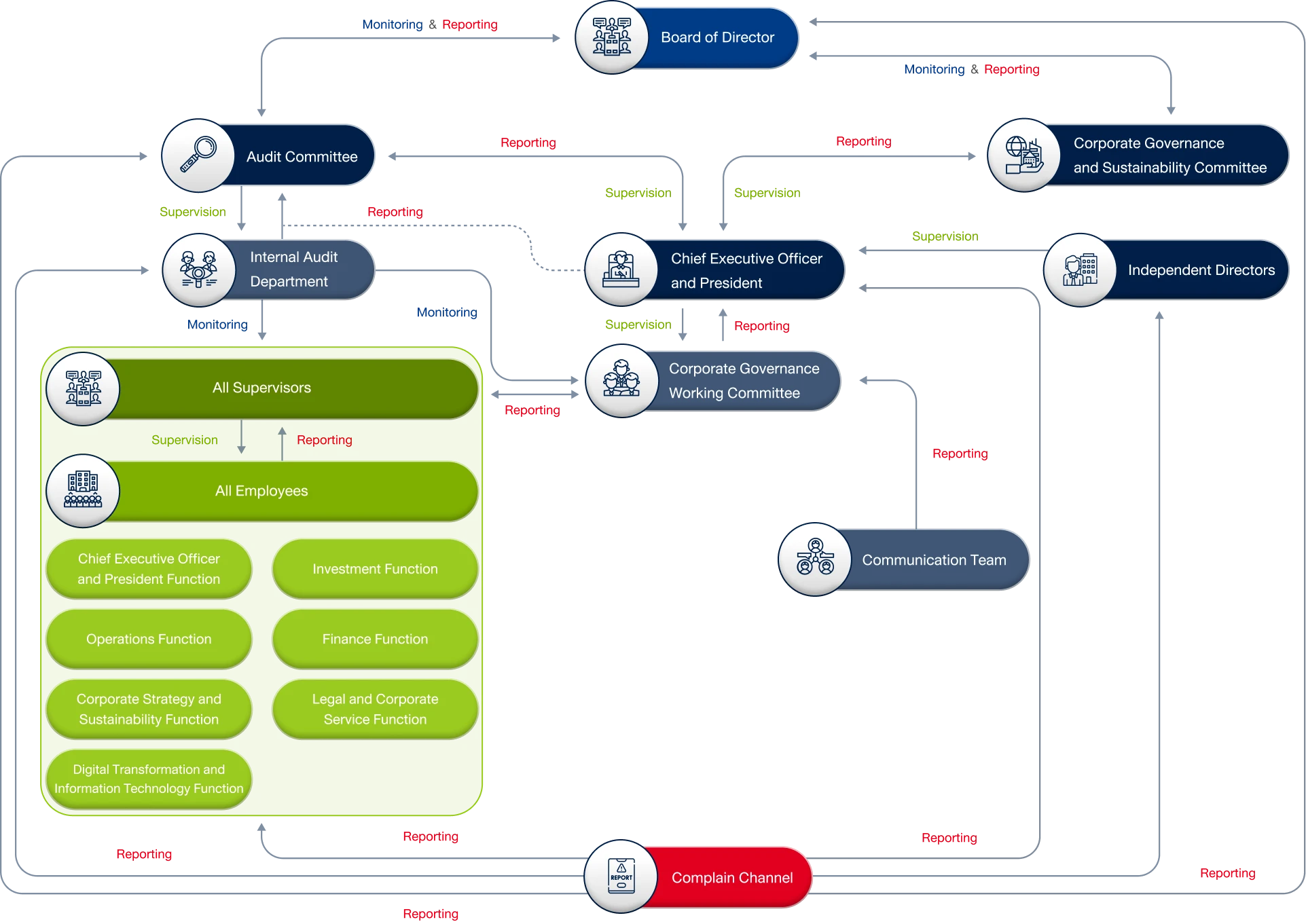
| Board of Directors: |
|
| Audit Committee: |
|
| Corporate Governance and Sustainability Committee: |
|
| Chief Executive Officer: |
|
| Corporate Governance Working Committee: |
|
| Internal Audit Department: |
|
| Supervisors: |
|
| Employees: |
|
| Communication Team: |
|
Key principles of Code of Conduct
The revised Code of Conduct, signed by the Company's Chairman, was effective on 19 December 2024 and published for the acknowledgement of all involved. All employees have signed the acknowledgement form. Its key principles are as follows:
| Business Practices |
|---|
|
| Treatments of Stakeholders |
|---|
|
| Operational Excellence |
|---|
|
| Safeguarding of Company's Information and Financial and Other Assets |
|---|
|
| Human Rights |
|---|
|
| Information Disclosure |
|---|
|
| Environmental Stewardship |
|---|
|
| Code of Conduct applies to: |
|---|
|
Whistleblowing Channel
Legal compliance
Legal compliance is a best practice included in the Code of Conduct, demanding:
- All of the Company's business operations must comply with applicable local and international laws, including trade competition or antitrust laws.
- All executives and employees must adhere to and seriously respect and comply with relevant laws and regulations.
- All executives and employees must acknowledge and comply with the requirements of laws and regulations in force or related to their job responsibilities.
- All executives and employees must cooperate and treat regulatory officers professionally with integrity.
- Executives must incorporate requirements and regulations that affect the Company's business operations into its strategic plan and business processes.
- There must be a team with relevant regulatory knowledge or expertise in government matters, including compliance risk management.
- All executives and employees are obliged to constantly monitor changes in new laws and regulations.
Compliance with Code of Conduct in 2025
All employees and personnel of the Company remained committed and strictly followed the Code of Conduct, resulting in zero breach incident. The evaluation on knowledge and understanding in the Code of Conduct remained a part of their annual performance evaluation.
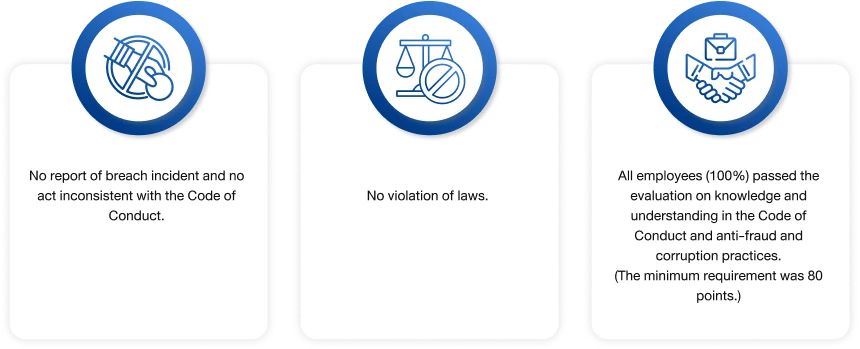
| Actions | results |
|---|---|
| Enhancement of employees’ knowledge/understanding in Code of Conduct | |
| Enhancement of employees’ knowledge/understanding in Code of Conduct |
|
| Actions in support of the Code of Conduct | |
| Anti-fraud and corruption and anti-bribery |
|
| Prevention of conflict of interest |
|
| Political neutrality |
|
| Anti-money laundering |
|
| Transactions with government sector |
|
| Fair competition |
|
| Use of inside information |
|
| Overseas operations |
|
| Sustainable development: |
|
Prevention of Conflict of Interest
The Company has established written policies and guidelines for preventing conflict of interest, which are incorporated into the Company’s Code of Conduct, Articles of Association, and regulations governing various committees. Directors, executives, and employees must sign an acknowledgement and commit to following these policies on their first day of work and during orientation. The Company reviews and updates the conflict-of-interest guidelines at least once a year in accordance with the process determined by the Board of Directors. All directors, executives, and employees must perform their duties to the best of their ability and make decisions based on the best interests of the Company, in compliance with laws and ethical standards. Any person having an interest in any matter under consideration shall disclose such interest to the meeting and leave the meeting room, shall not participate in the consideration of the transaction, and shall have no voting right on that matter. The Company has also continuously communicated and provided knowledge on conflict-of-interest prevention to directors, executives, and employees, who have acknowledged and agreed to comply with the policy on an ongoing basis, through Board of Directors’ meetings and internal communication channels such as Line application or email.

In addition, directors and executives are required to submit a report of their vested interests and those of related persons upon assuming their positions and whenever there is any change in such interests, using the prescribed Conflict of Interest Disclosure Form. The Company Secretary is responsible for maintaining such reports and forwarding copies to the Chairman of the Board of Directors and the Chairman of the Audit Committee. Thereafter, such reports shall be submitted at least once a year, on 1 June of each year.

For subsidiaries, affiliates, and joint ventures, the Company has established processes and guidelines to supervise and monitor operations through the Company’s representatives serving as directors or executives in those entities, who are required to comply with the same practices. The chief officers of all functions are required to attend meetings and report the operations, issues, and obstacles of subsidiaries, affiliates, and joint ventures to the Audit Committee and the Board of Directors on a regular basis, or at least once per quarter.
In cases where the Company and/or its subsidiaries or companies within the group engage in similar business activities, measures are implemented to prevent conflicts of interest, with due regard to the best interests of the Company.
More Info:
Political neutrality
The Company strictly adheres to the principle of political neutrality, as stipulated in our Code of Conduct. We remain entirely impartial and do not align with or provide support to any political faction. The Company explicitly prohibits all forms of political contributions and donations, whether in cash or in-kind, to political parties, political candidates, or political organizations. Furthermore, we do not provide financial backing for political activities, nor do we permit the use of corporate resources or facilities for political purposes. However, the Company respects the personal rights and freedoms of its employees to participate in political activities outside of working hours, provided such engagement is strictly in a personal capacity and does not represent the Company.
In 2025, the Company consistently maintained its political neutrality. Zero political contributions or donations were made with the intent of influencing government decision-making or public policy, and the Company did not engage in any direct or indirect lobbying activities.
In the ordinary course of business, the Company engages with government agencies and participates in relevant business and industry associations. These engagements are conducted appropriately to discuss legal requirements, secure operational licenses and approvals, and exchange perspectives on industry-related public policies. To ensure integrity, the Company has established clear roles and responsibilities for such engagements. Designated departments coordinate and oversee these activities, ensuring strict compliance with applicable laws, our Code of Conduct, and corporate policies.
For any material public policy issues, the decision-making process is escalated to executive management for review and approval. Executive management is directly responsible for providing oversight, ensuring that any public policy engagement robustly aligns with the Company’s strategic direction, Climate Commitments, Code of Conduct, and all relevant legal and regulatory frameworks.