





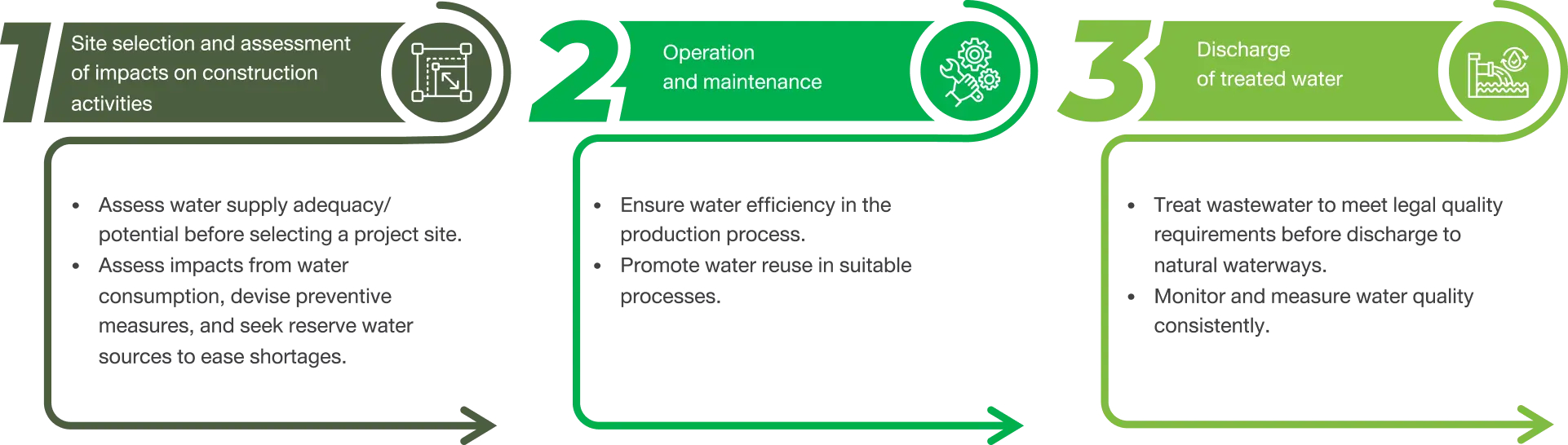
As water is an important factor for electricity generation, the Company Group has to assess water demand andthe capacity of water sources in the locality, for the consideration of project sites. In addition, the Group assesses the possibility of reserve water sources to cope with the shortage issues of primary water sources, either due to seasonal shortage or fight for water following changes in land use or a population increase or climate change including the El Nino phenomenon that takes place every 2-7 years on average and leads to drought especially in Southeast Asiawhere the Group’s major power plants are located.
The Group’s power plants have rolled out measures for responsible water resource management, taking into account the adequacy of water sources and impacts on community and the ecosystem.
Water management targets
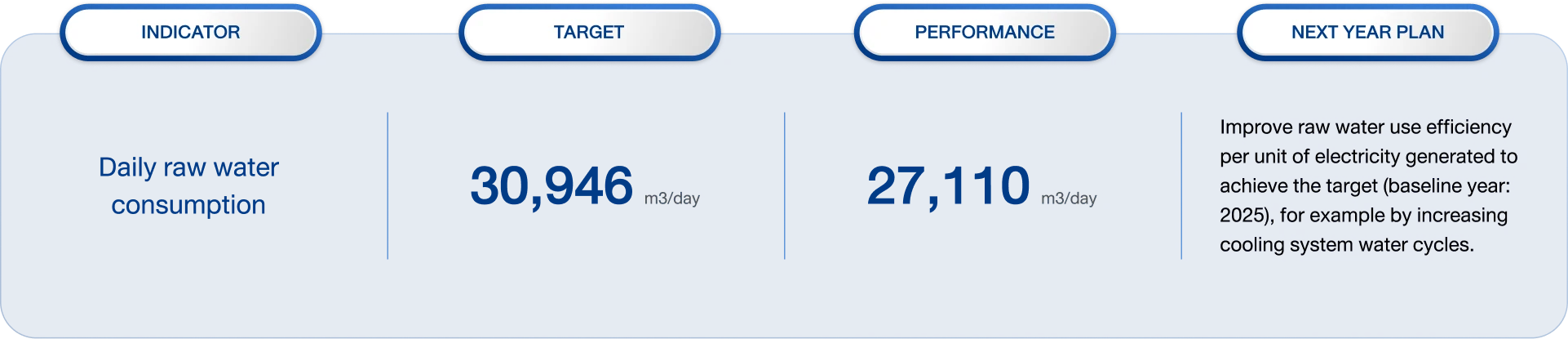
Water management targets are primarily established for large-scale power plants. At Hin Kong Power Plant, the targets focus on the daily volume of raw water withdrawal to ensure effective control and maintain generation efficiency.
Water Stress Assessment and Production Management
Therefore, the water risk assessment procedure is integrated into the Environmental and Social Management System (ESMS), as a tool to assess the correlation of the Company’s water consumption and other users in the same locality as well as possible impacts on community, the ecosystem and other industrial users. The assessment applies tools and database according to universal standards such as WWF Water Risk Filter and WRI Aqueduct. It covers various aspects of risks concerning laws and regulations, quality and quantity of water, reputation, and relationship with stakeholders. The results are used in formulating a water management plan that suits the context of each project.
Raw water sources and sensitive areas
In 2025, the Mae Klong River Basin, the Chao Phraya River Basin, and the Bang Pakong River Basin remained the primary water sources for RATCH Group’s electricity generation

The Company has monitored the situations and assessed the water stress in each river basin on a continuous basis, to ensure water efficiency and not to cause significant impacts on other users in line with the sustainable water consumption principles.
The water stress assessment in 2025 showed a high-water stress level (at 40-80%) in the Chao Phraya River Basin and the Bang Pakong River Basin. The Company has set guidelines for the risk management and established measures to appropriately control power plants’ water efficiency based on the context of each location. The goal is to maintain power plants’ generation capacity and to avoid conflicts or competition for water.
| Power Plant | Water Source | Water Stress Level Withdrawal | Withdrawal Volume (Cubic Meters) |
Discharge Volume (Cubic Meters) |
Water Consumption (Cubic Meters) |
||
|---|---|---|---|---|---|---|---|
| Low-Medium (10-20%) |
Medium-High (20-40%) |
High (40-80%) |
|||||
| Ratchaburi | Mae Klong River | - |  |
- | 767,192 | 568,866 | 198,326 |
| Hinkong | - | |
- | 9,895,251 | 2,245,883 | 7,649,368 | |
| RATCH Cogeneration | Tap water from the Chao Phraya River | - | - | |
960,850 | 142,717 | 818,133 |
| Ratch Energy Rayong | Bang Pakong River Basin | - | - | |
709,376 | 121,339 | 588,037 |
| Ratch Pattana Energy | - | - | |
1,396,328 | 475,182 | 921,146 | |
A future water stress assessment using the WRI Aqueduct risk projection model for 2030, 2050, and 2080 was conducted for the three power plants located in high-risk areas—namely RATCH Cogeneration Power Plant, RATCH Energy Rayong Power Plant, and RATCH Pattana Energy Power Plant. The findings indicate that all three sites fall within the 'High' to 'Extremely High' risk categories from 2030 through 2080.
Response to water risks and building resilience
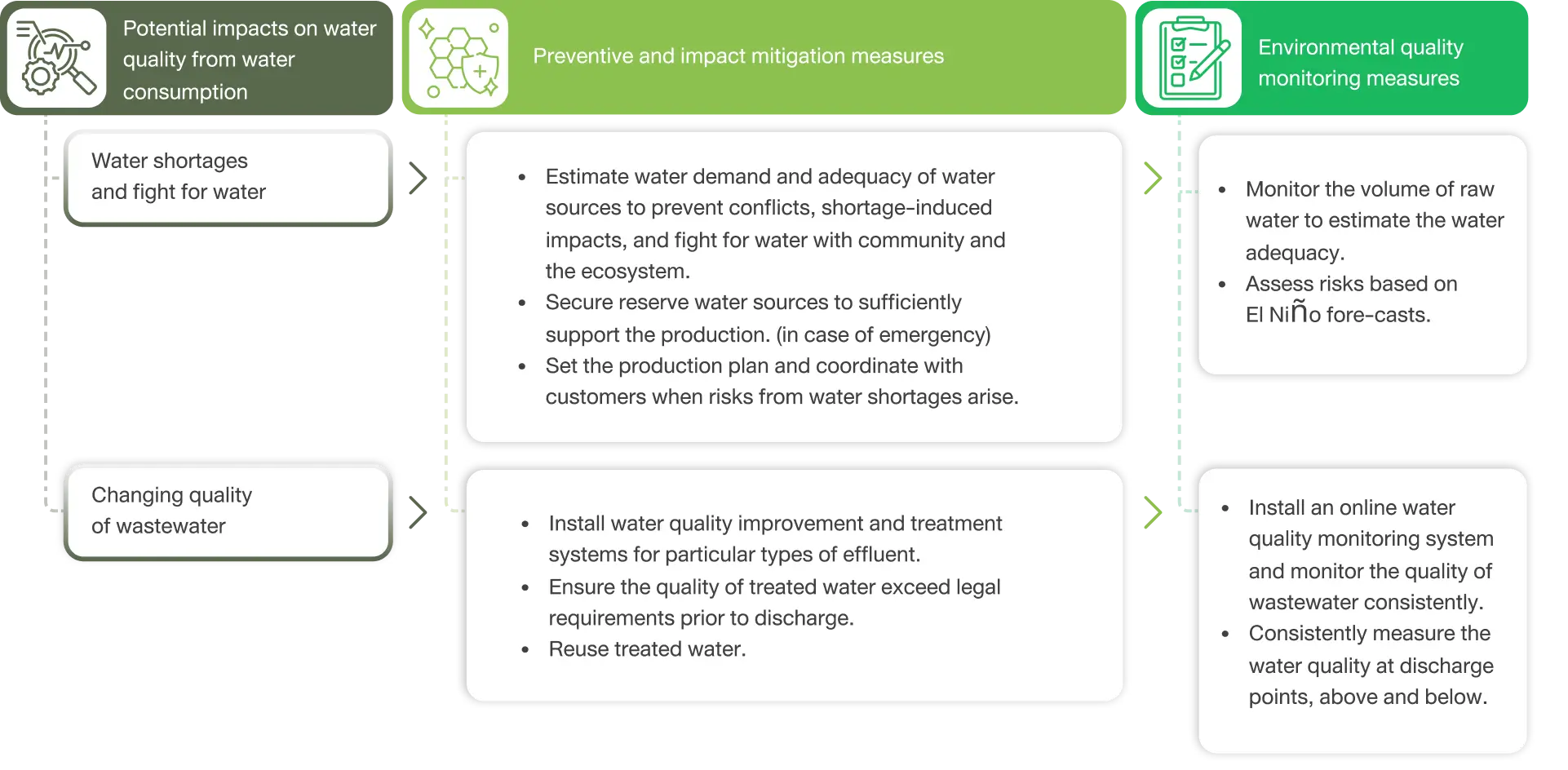
Preventive and adaptive water management measures are defined based on the water stress assessment results, to build the operational resilience against climate physical risks. The measures call for the enhancement of water use efficiency, reserve water planning, wastewater management, and coordination with local government agencies and community. With these measures, the Group has ably reduced shortage-related risks in the long term and maintained a balance of water use with stakeholders, and foster stable business growth.
Guidelines for risk management and water resource management measures
Appropriate risk management and water resource management measures have been established for the power plants located near the river basins with high water stress level, to achieve business continuity and ensure water use efficiency without creating impacts on local stakeholders. The key measures are as follows:
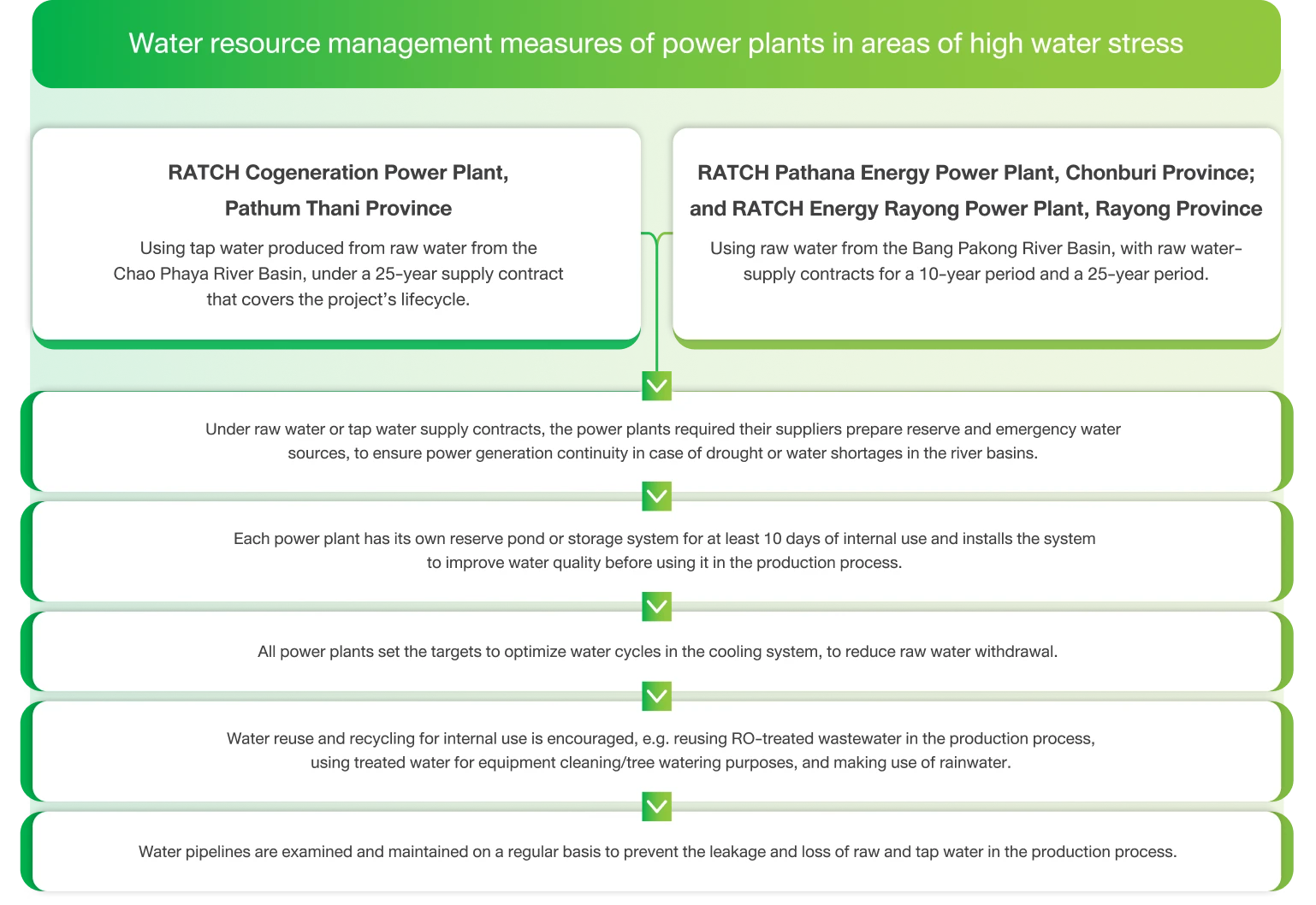
Water recycling in production process, to reduce raw water withdrawal
All power plants have set the targets to optimize water cycles in the cooling system which hence minimizes raw water withdrawal from natural water sources. The 5 power plants accounting for 50% of fossil-fuel generating capacity, which were operational in 2025, achieved their water cycle targets.
| Power plant | Location | Number of cooling system water cycles | |
|---|---|---|---|
| Target | Average Water Cycle | ||
| Ratchaburi Combined Cycle Plant 3 Units (total 2,175 MW) |
Ratchaburi | Not applicable due to reserved shutdown status and short-term dispatch operation. | |
| Hin Kong 2 Units (1,540 MW) | 4-5 | 4.08 | |
| RATCH Cogeneration (119.75 MW) | Pathum Thani | 8.5 | 8.71 |
| RATCH Cogeneration (Expansion Phase) (31.2 MW) | 8.5 | 7.82 | |
| RATCH Energy Rayong (98 MW) | Rayong | 5-10 | 6.43 |
| RATCH Pathana Energy (153 MW) | Chonburi | 5-13 (Block 1) | 8.86 |
| 3-8 (Block 2-3) | 4.56 | ||
Net water consumption
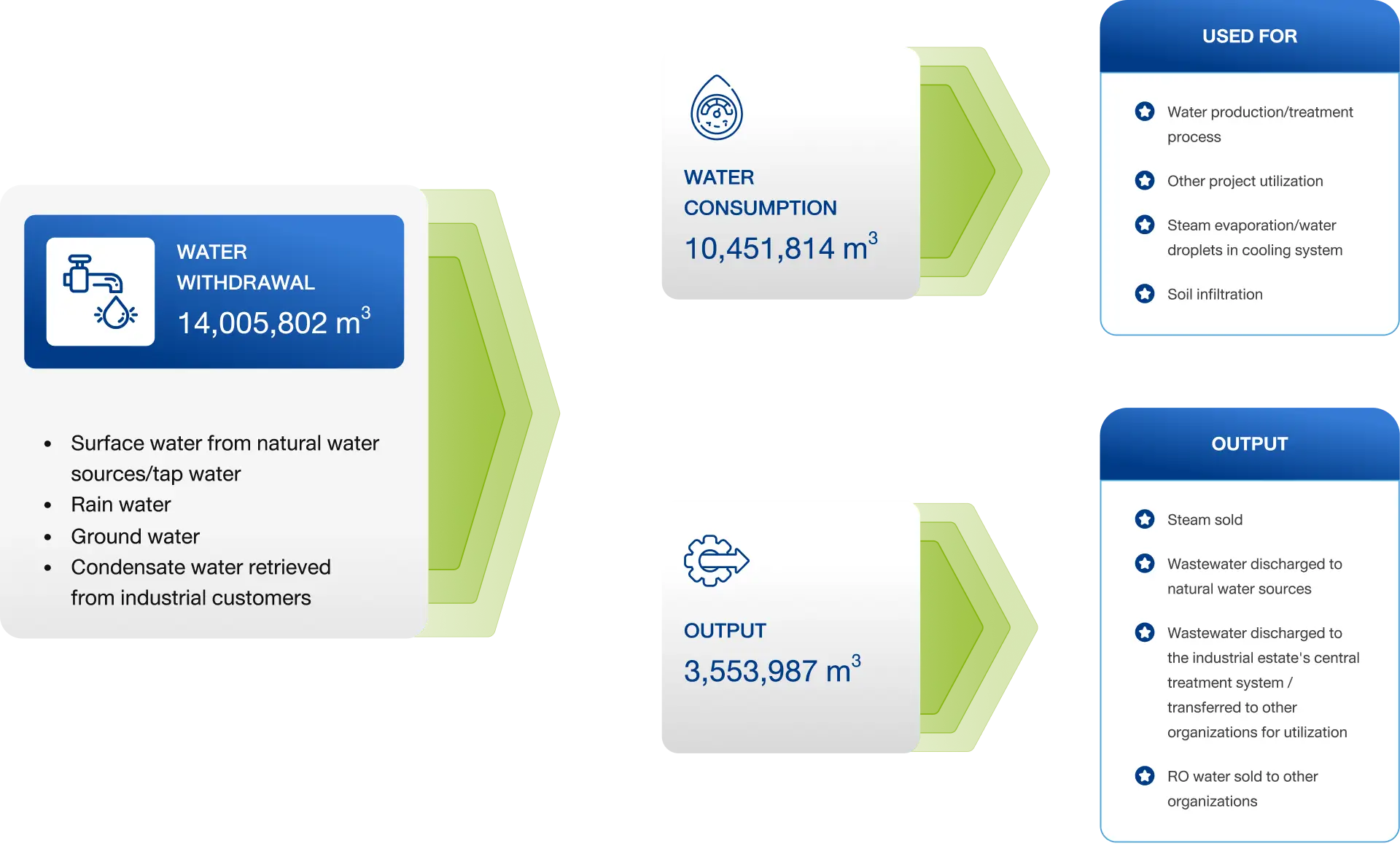
In the year, the 5 power plants in Thailand (contributing 59.53% of total revenue) withdrew a total of 14,005,802 cubic meters for electricity generation, while the output or water released to natural waterways totalled 3,553,987 cubic meters (or 25% of input). The net water consumption was 10,451,814 cubic meters or 75% of inflows.
Wastewater management and discharge
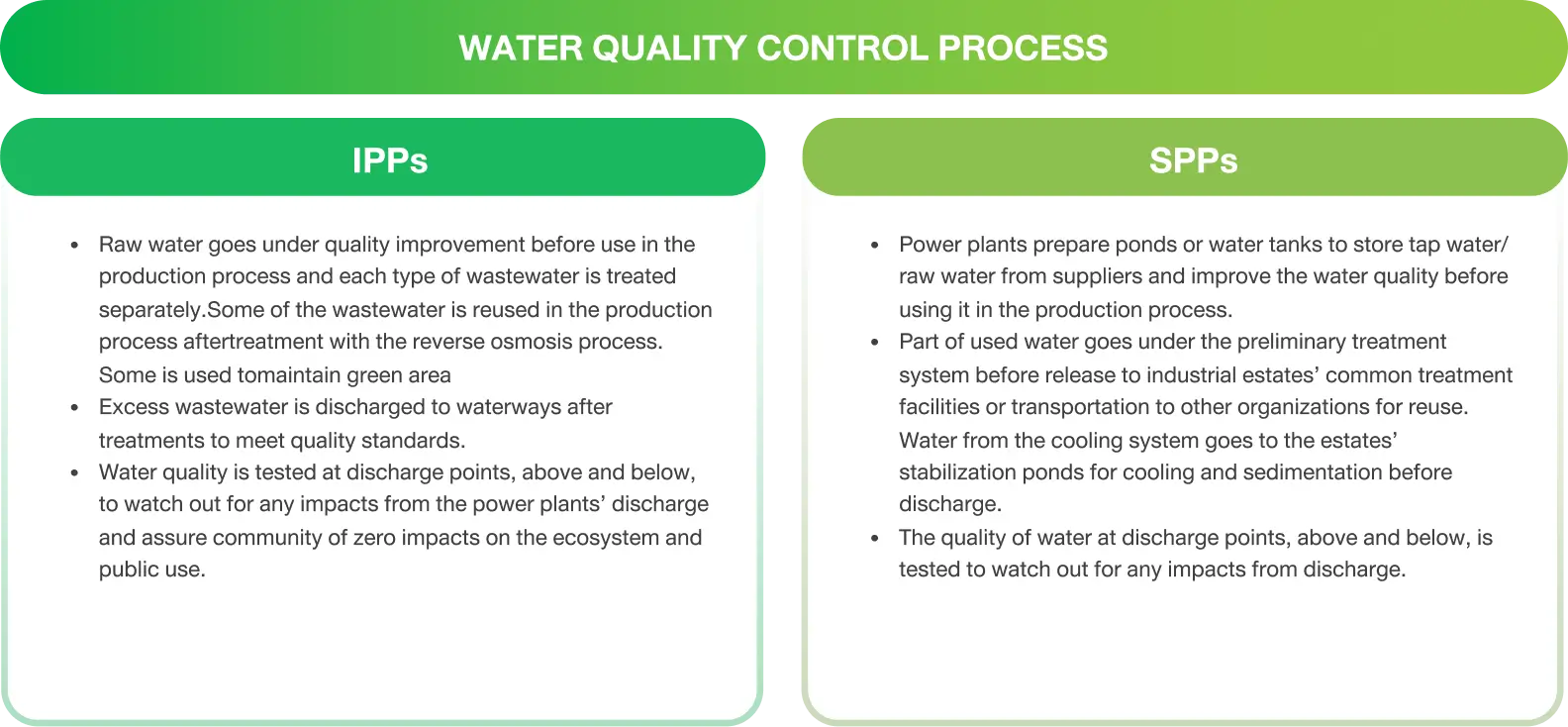
The Company’s power plants have applied wastewater treatment methods to meet legal requirements before discharge. Treated water is released to natural waterways or, if the power plants are located inside industrial estates, common treatment facilities and drainage system which controls wastewater quality according to the Industrial Estate Authority of Thailand’s standards and requirements.
All power plants, with own treatment systems and releasing treated water directly to waterways, treat each type of wastewater appropriately such as neutralization and aeration to meet the water quality requirements prior to discharge. Approximately 80-90% of wastewater exchanged heat in the cooling system for a number of cycles, before going to the sedimentation ponds. The temperature is then lowered to meet legal standards and near natural condition before discharge, to minimize impacts on the ecosystem and neighboring communities’ consumption.
More Info: