





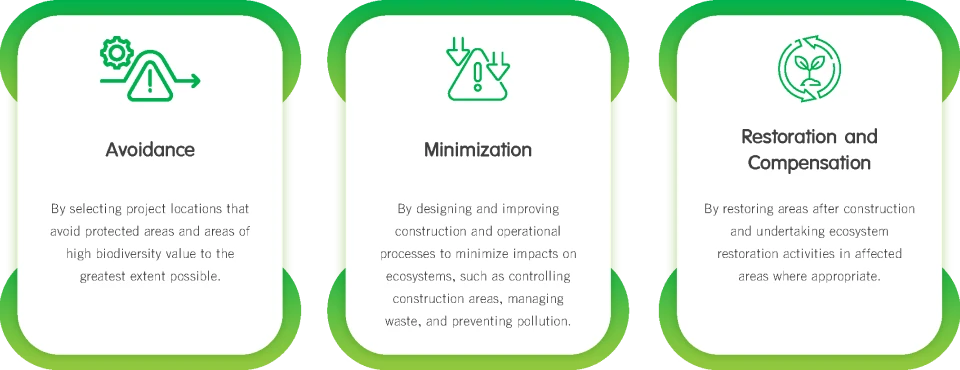
RATCH is aware of the importance of biodiversity which is the natural resource foundation that supports key ecosystem services and sustainability of the electricity and energy business. The importance is vivid for the projects involving land use, construction and operation in sensitive areas. The Company’s biodiversity management focuses on Avoid, Minimize, and Restore (Mitigation Hierarchy) and applies to subsidiaries in the scope of consolidated financial statements. Priority is given to areas with biodiversity value or areas near protected areas.
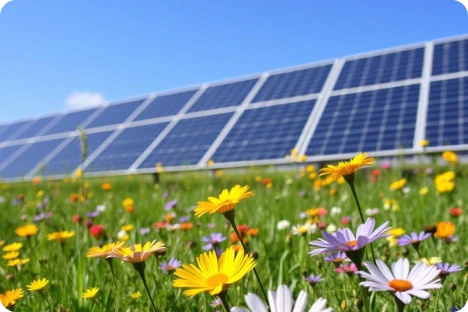
The Company has identified and assessed impacts on biodiversity from subsidiaries’ activities in each stage of project lifecycle – development, construction, and operation, taking into account important factors such as land use and land use change, disturbance of plants and animal habitats, utilization of water and natural resources, and operations in or near ecologically-sensitive areas. The assessment results are used in the formulation of preventive and impact mitigation measures suitable to the context of each project.
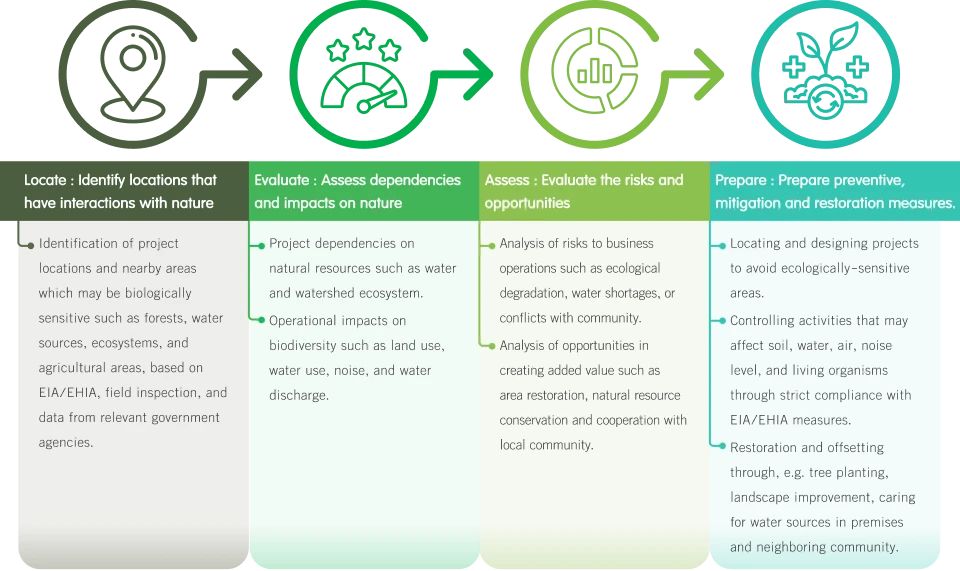
The Company Group’s business entities, in Thailand and abroad, have fully complied with relevant legal and requirements, particularly concerning the preparation of EIA reports as well as preventive, corrective, and restoration measures for biological resources. Priorities are given to the maintenance of habitat conditions, the existence of ecological structure, and resource utilization in a way that does not cause competition, fight or impacts on neighboring community. The Group has started to apply the Taskforce on Nature-related Financial Disclosures (TNFD) framework, for new development projects or mergers and acquisitions. The risk identification and assessment process has the following steps:
Mitigation Measures
Mitigation Measures: Green Area Development
The Group’s major power generation facilities in Thailand have implemented environmental impact mitigation measures by requiring the development of green areas covering not less than 5% of total project land area. This is achieved through tree planting within project sites to promote ecological balance and enhance environmental quality within operational areas. For example, Ratchaburi Power Plant, with a total project area of 2,014 rai, has developed green areas covering approximately 745 rai, representing 36.98% of the total project area. The planted species include perennial trees such as Big-leaf Mahogany (Swietenia macrophylla), Teak (Tectona grandis), Neem (Azadirachta indica), and other tree species appropriate to local environmental conditions and ecosystems.
Monitoring of biodiversity management
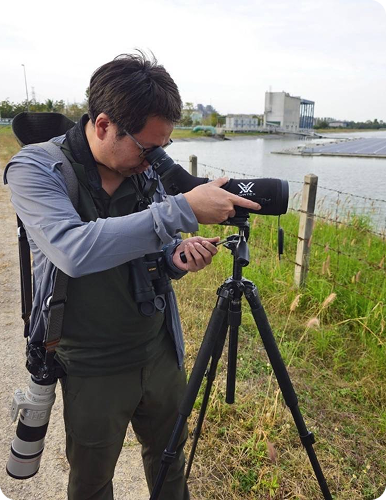
Subsidiaries’ biodiversity management has been monitored via indicators suitably designed for each investment project. They include the number of projects located in or near ecologically-sensitive areas, areas where ecosystems have been restored or improved, and compliance with environmental and ecological requirements as specified in the EIA. The monitoring results are used to evaluate the management efficiency and plan continuous improvement.
| Summary | No. of project (Site) | Area (hectare) |
|---|---|---|
| Projects Currently in Operation | 16 | 16,851.18 |
| Projects with Biodiversity Impact Assessment | 15 | 16,846.42 |
| Projects with Potential Biodiversity Impacts | 5 | 15,752.60 |
| Projects with Biodiversity Management Plans | 5 | 15,752.60 |
Biodiversity studies at IPPs in Thailand
| Ratchaburi Power Plant (322.4 hectares) | |
|---|---|
| Impact assessment and monitoring measures | |
|
|
| Monitoring results in 2025 | |
| 114 species of wild animals | 91 species are protected under the Wildlife Reservation and Protection Act B.E. 2562 (2019). |
|
2 species - Pteropus lylei and Pipistrellus javanicus |
|
3 species - Calotes versicolor, Varanus salvator and Malayopython reticulatus |
|
86 species, protected mostly because of their natural beauty or their help in attacking agricultural pests, including Caprimulgus asiaticus, Cypsiurus balasiensis, Himantopus Himantopus, and Ardea purpurea |
|
None |
| Wildlife classification by conservation status | |
By status of threatened wildlife in Thailand in 2020: 114 species were classified threatened species.
|
|
By International Union Conservation of Nature; IUCN (2025)’s status classification: All 114 species are:
|
|
| Changes from previous year | |
|
|
| Aquatic living beings (phytoplankton, zooplankton, and benthos) | |
|
|
| Hin Kong Power Plant (30.21 hectares) | |
|---|---|
| Impact assessment | |
|
Terrestrial biological resources The operation does not cause loss of forest areas as the project is surrounded by agricultural land, urban areas and Khao Wang, a military forest zone. During the construction stage, wildlife may be affected by noise and air pollution but in the operational stage, they can return to the surrounding areas for their habitats and a food source. |
Aquatic biological resources In the operational stage, the effluent quality may affect aquatic biological resources like phytoplankton, zooplankton, benthos, aquatic animals and aquatic plants. |
| Monitoring measures | |
| Only aquatic biological resources in Mae Klong River, the project’s discharge point, were monitored at the point of discharge, and 500 meters up and down, twice a year (during rainy and dry seasons). Under the monitoring were the sum of species, density and diversity index, covering phytoplankton, zooplankton, benthos, aquatic animals and aquatic plants. | |
| Monitoring results | |
|
Aquatic living beings The diversity index of phytoplankton, aquatic animals and aquatic plants at 3 monitoring points was quite similar, with that of phytoplankton being the highest. The diversity index of zooplankton, benthos and aquatic plants was the highest at the discharge point. Based on the Wilhm and Dorris biological parameters (1968), the results showed the water quality at all monitoring points in both seasons remained liveable (with the diversity index above 1.0). |
|
Biodiversity studies at renewable power plants abroad
| Power Plant | Significant impacts | Environmental quality monitoring measures |
Monitoring results in 2025 |
|---|---|---|---|
| Collinsville Solar Farm (70.9 hectares) | The assessment of impacts on the environment and biodiversity from the operation showed no risk or impact on living beings. | No monitoring measure | No monitoring measure |
| Mt. Emerald Wind Farm (2,400 hectares) | The construction and operation can affect animal habitats, abundance and species. | Monitoring frequency for bats and quolls adjusted to every five years due to low impact risk based on surveys during 2020–2023. Next surveys scheduled for 2030 (bats) and 2028 (quolls) at five monitoring sites, including two within the project area. | Bat population surveys and carcass monitoring found no significant impacts from project operations, and no carcasses of protected or rare bird or bat species were recorded. The latest quoll population survey also indicated no significant impacts from project operations. |
| Collector Wind Farm (6,200 hectares) | The construction and operation cause impacts on plants, animals, forest land and pastures. | Tracking the sum and species of birds and bats annually and sur-veying animal carcasses on a monthly basis. | Annual bird and bat surveys and monthly carcass monitoring recorded 19 birds and bat carcasses at the sampling sites, including two protected bird species. |
| Lincoln Gap Wind Farm (1-2-3) (6,800 hectares) | The construction and operation cause impacts on plants, animals, forest land and pastures. | Tracking the sum and species of birds and bats annually and surveying animal carcasses on a monthly basis. | Annual bird and bat surveys and monthly carcass monitoring recorded only one protected bird carcass at the sampling sites, located relatively far from the wind turbine. |
| Snapper Point Power Station (gas-fired) (27.3 hectares) |
|
||
| Asahan-1 Hydroelectric Power Plant (40.9 hectares) | The construction and operation of the project have an impact on plant species, forest areas, and animal habitats. | No monitoring measures are specified, but measures are established to restore forest resources to replace forest areas lost due to development projects. | By 2025, the project had planted a total of 5,000 trees around the watershed of Lake Toba, Toba City, North Sumatra Province, to restore forest resources and ecosystems lost due to previous projects. Over 15 years, the project has planted a total of 75,000 trees. |
Governance and development
The biodiversity governance is under the Environmental and Social Management System (ESMS) framework, with a continuous monitoring and reporting mechanism that involves the Management and the Board of Directors. The Company is considering to step up the environmental and biodiversity management for more systematic and effective results. The priority will be given to the assessment of environmental and biodiversity risks, efficient use of resources, restoration of operating areas’ ecosystem to support new projects, and the development of a continuous biodiversity monitoring and reporting system. Meanwhile, the Company is being prepared for nature-related financial disclosures, with the plan to develop biodiversity baselines in major operating areas. The data will support quantitative target setting, monitoring, and consideration of opportunities relating to nature markets such as biodiversity credits which will foster the creation of economic, social and environmental values.