





Risk and Opportunity Management
RATCH is committed to responsible operations in order to attain sustainable growth and long-term value for both the Company and stakeholders across the value chain. Risk and opportunity management is thus a priority, as a critical factor that can induce positive and negative impacts on the Company’s business capabilities and continuity. As a holding company, RATCH emphasizes the management of risks and opportunities across the entire group, encompassing economic, environmental, social, governance (ESG), and human rights dimensions.
Risk and opportunity management has been incorporated into the strategic planning process, asset management, investment decision-making, operation monitoring and the supervision of subsidiaries, based on the Company’s role and control level in each subsidiary, covering businesses under the Company’s operational control and businesses which are financial investments. Moreover, in the risk and opportunity identification process, the Company prioritizes the issues significant to assets and investments in power and energy projects such as a change in power and energy regulations, the Power Development Plan, trends of transition to clean energy, emission targets, climate change, IT/cyber security and AI, governance, human rights, stakeholder expectations, etc. The approach enables the Company to deal with volatility, effectively mitigate negative impacts, shape value-creating businesses, enhance competitiveness, and support the organization’s sustainable growth.
COSO ERM Framework
RATCH has applied COSO Enterprise Risk Management Framework (COSO-ERM) in establishing the risk management policy, guidelines and procedures for the systematic and effective management of Group-level risks and opportunities, so as to drive corporate strategies and ensure prompt responses to a change in business context. As guided by the framework, the Company’s enterprise risk management is structured around its 5 interrelated components which are:
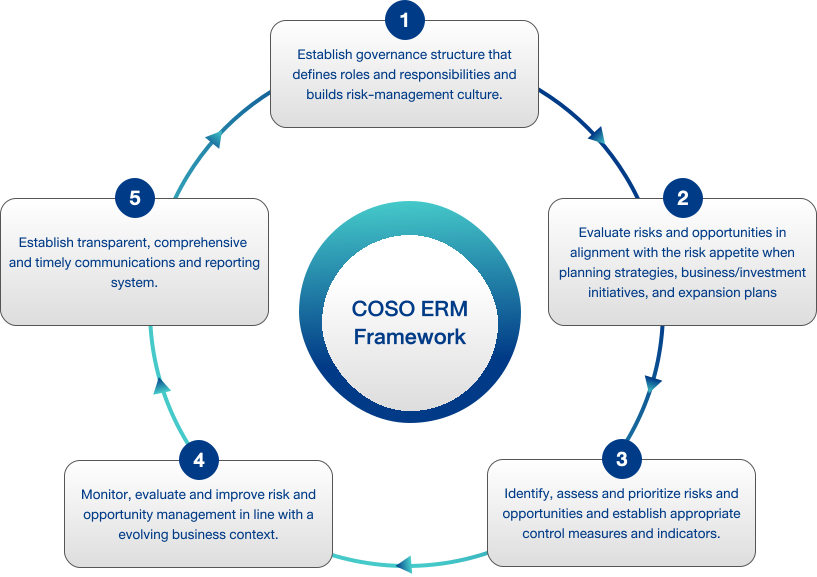
RATCH takes into account multi-dimensional risks, from strategic risks, operational risks, financial risks, and compliance risks to environmental, social and governance (ESG) risks. The Group-level risk appetite is set as the baseline for asset management and investment activities. The risk and opportunity management also incorporates other universal management approaches such as Task Force on Climate-related Financial Disclosures (TCFD) and GRI requirements, to address stakeholder expectations, ensure transparent information disclosure and strengthen corporate credibility.
In 2025, RATCH developed and announced the implementation of the Enterprise Risk Management (ERM) Manual, referencing the international frameworks COSO Enterprise Risk Management – Integrating with Strategy and Performance and Enterprise Risk Management – Applying ERM to Environmental, Social and Governance-related Risks as guidelines for implementation. The Company also enhanced knowledge, understanding, and risk awareness among executives and employees at all levels to ensure that risk management is systematic and integrated across the organization, supporting sustainable growth.
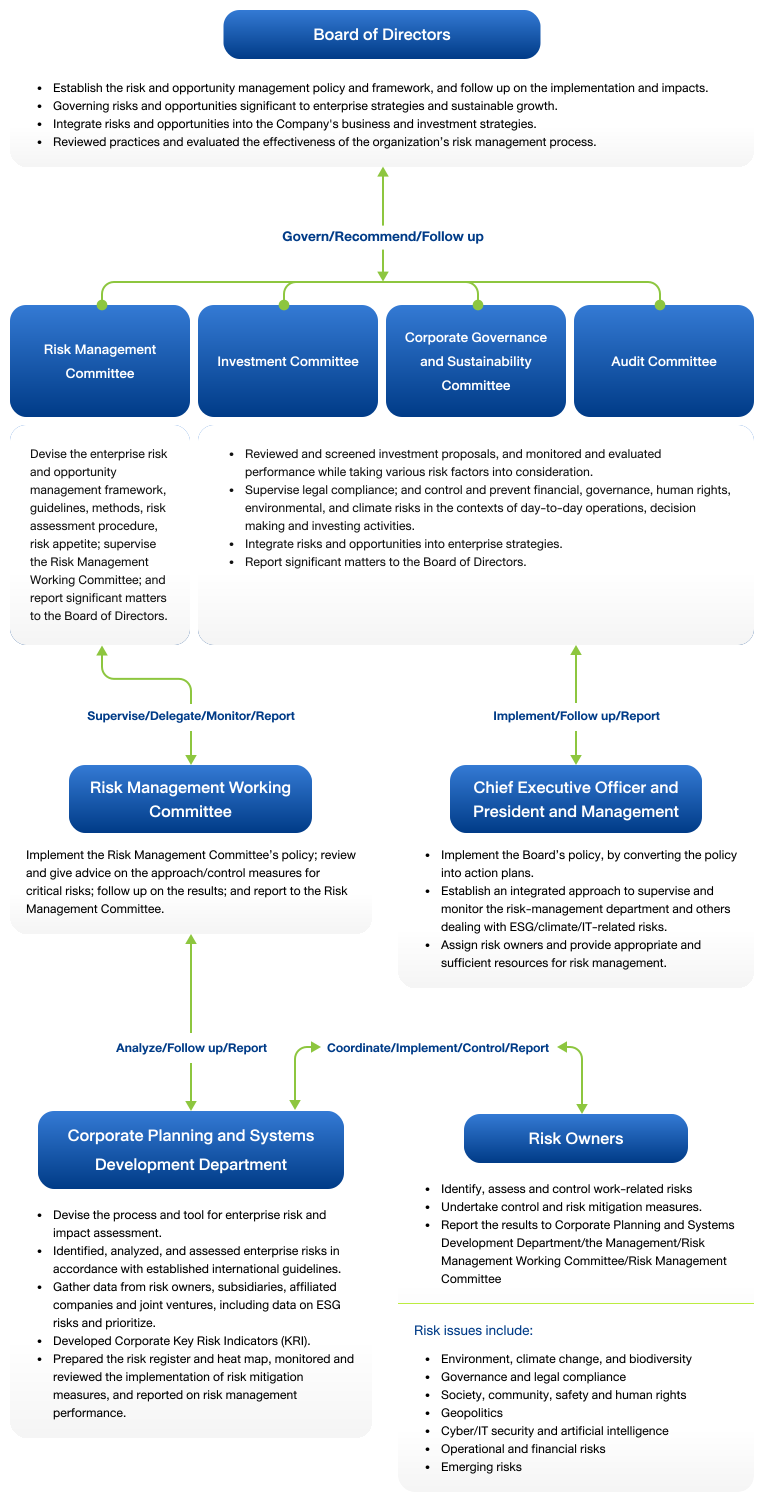
Enterprise risk management oversight structure
RATCH’s enterprise risk management (ERM) is caried out under the supervision structure that connects the Board of Directors and the Management with the operational level. Job descriptions are clearly defined, for systematic, transparent and prompt actions in light of swift changes in the energy industry that may affect the Company’s businesses.
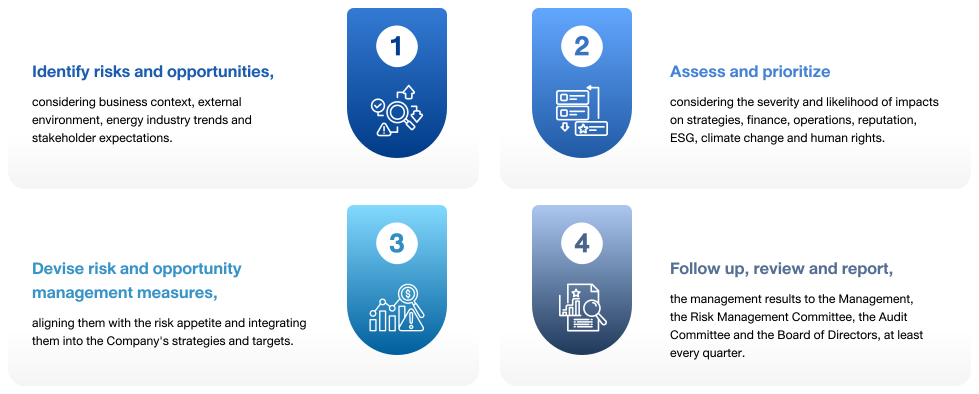
Risk and opportunity management process
RATCH has established a systematic process for enterprise risk and opportunity management, in order to identify, assess and deal with the risks and opportunities that may influence the operations, strategic decisions and the sustainability of value creation. The process covers entities under the Company's management control and those that are financial investments. The key steps are as follows:
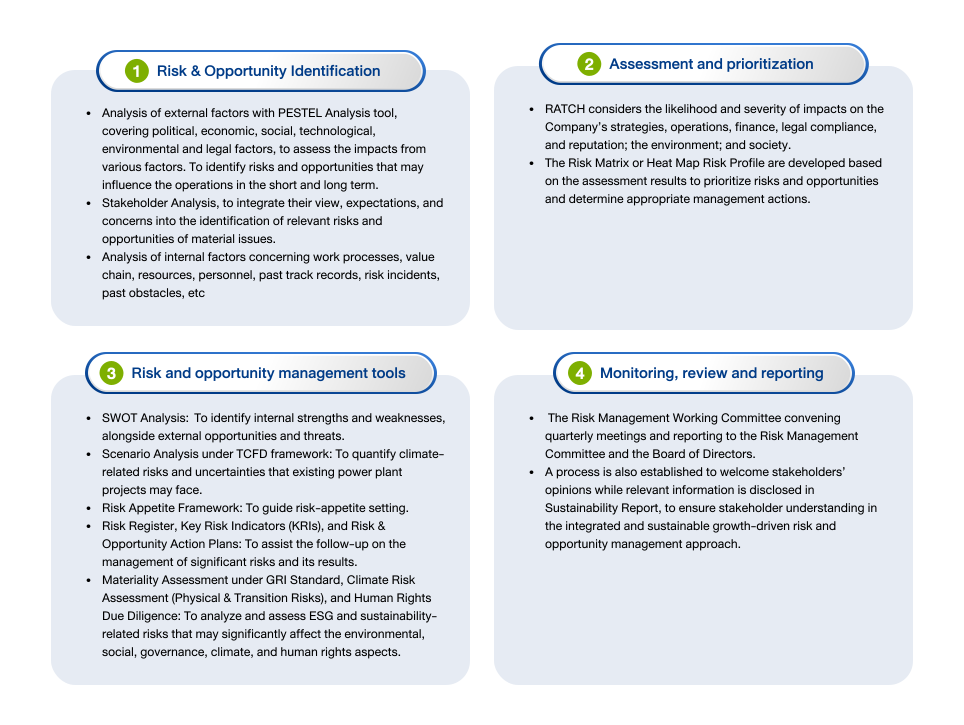
Risk and opportunity management methods and tools
Risk and opportunity management methods and tools are tailored in accordance with the business context of a power and energy holding company. Various tools have been adopted to identify, assess and manage risks and opportunities in economic, social, environmental, IT and governance aspects, to ensure a holistic management approach and support sustainable strategic decision-making. They are summarized as follows:
The Company conducts risk assessments based on two primary parameters: Impact and Likelihood, utilizing a 1–5 rating scale for each parameter.
- Impact: Evaluates the potential severity of a risk event across relevant dimensions, such as financial, operational, legal and regulatory, reputation, environmental impact, and strategic goal achievement. For the financial dimension, the Company applies quantitative by assessing the potential financial impact against the Company’s defined financial basis.
- Likelihood: Evaluates the probability of a risk event occurring, taking into account historical event data, emerging trends, relevant statistics, industry benchmarks, and professional judgment from executive management or subject-matter experts as appropriate.
The ratings for impact and likelihood are integrated into a Risk Matrix to derive a Risk Score. This score enables risk prioritization and the formulation of appropriate risk treatment plans. Following the implementation of control or mitigation measures, the Company assesses the Residual Risk remaining after risk treatment.
Regarding Risk Appetite, the Company establishes tolerances aligned with its corporate strategy and risk-bearing capacity.
For financial impacts, the risk threshold is set at a financial impact not exceeding 1% of the Company's defined financial basis. Risks exceeding this threshold trigger additional mitigation measures and escalation through established risk management procedures.
Residual risk assessments, coupled with defined risk appetite and risk thresholds, guide ongoing monitoring, decision-making regarding risk mitigation or avoidance, and formal reporting to executive management and relevant committees based on risk severity levels.
Integrating risks and opportunities into strategies and decision making
The results of risk and opportunity management are integrated into the strategic planning process, asset management, investment and financial management, to reach thorough decisions which can reduce impacts and enhance value-creation opportunities for the Company in the long term. The information on significant risks and opportunities is reported to the Management and relevant committees to support informed decisions regarding new investment projects, business expansion and asset management in line with risk appetite and the Company Group’s sustainability targets.
Aside, the analysis on risks and opportunities is the basis for the setting of strategic ESG targets and enterprise plans, in support of solid and sustainable business prosperity.

Linkage between risks and material topics
Enterprise risks serve as inputs for the assessment of material topics concerning economic, social, environmental and governance sustainability. The assessment results then are integrated into the identification and prioritization of enterprise risks in terms of strategic planning, operations, finance, legal compliance and reputation. The management and follow-up approach is also established for material risks, and the results are disclosed in accordance with GRI Standard.
Opportunity management
RATCH views that uncertainties or changes, considered risks, may be the opportunities to create value. The Company has analyzed and assessed business opportunities that may rise from energy transition, technological changes, regulatory changes, climate change, innovations, digital technology, and artificial intelligence. Potential opportunities have been identified and incorporated into the Company’s strategic planning for further development in new energy sectors and emerging business opportunities.

Material risks and opportunities
RATCH has identified and assessed the risks and opportunities material to the Company Group’s business operations and creation of sustainable value, considering primarily the impacts on strategies, operations, finance, legal compliance and reputation. The material risks and management approaches are summarized below:
| Material risk | Management approach | |
|---|---|---|
| 1. Climate-related | ||
| Energy transition, greater demand for clean energy, carbon/emission management policy
More info:
|
|
|
| 2. Legal compliance-related | ||
| Changes in legislation and regulatory oversight in the power, energy, and environment oversight structure that influence the business model, costs and legal compliance Changes in legislation and regulatory oversight in the power, energy, and environmental sectors that may impact the business model, costs, and legal compliance. |
|
|
| 3. Supply chain-related | ||
| Management of contracts to assure suppliers’ compliance, particularly in the construction and operation stages as well as the safeguarding of safety and occupational health for their job operators
More info:
|
|
|
| 4. Governance-related | ||
| Transparency and governance of subsidiaries and joint ventures as well as environment and social management |
|
|
| 5. Technology-related | ||
| Cyberattack that may lead of the leakage of personal data and business confidentiality and responsible application of AI
More info:
|
|
|