






RATCH upholds fair labor practices and labor standards enshrined in national labor laws that are based primarily on the International Labor Organization standards. Fair practices concern labor management, work environment and use of labor, encompassing, for example, wage, working hours, holidays, leave, termination, treatment of female workers, prohibition of child labor, safety and occupational health, welfare for labor social security, and capacity building. All are to ensure their happiness, morale and preparedness to do their best in delivering quality products and services to customers, which will in turn enhance the company’s competitiveness and warrant job and social security for all employees. Regarding employment security, the Company strictly complies with all labor laws and regulations pertaining to employee termination. This includes adhering to statutory requirements for minimum advance notice periods in both standard terminations and potential mass layoffs. However, driven by our strong commitment to sustainable human resource management, the Company has never experienced a mass layoff.
The Company has complied by the Employment of Persons with Disabilities Act, B.E. 2550 and revised edition (2nd revision) B.E. 2556 that the employers or owners of the establishments who do not employ persons with disabilities at the proper proportions as prescribed in section 33, accordingly the company has continually contributed money to the fund pursuant for the promotion and development of the disable people’s quality of life on yearly basis.
Personnel management and development framework


Structure of human resource management supervision
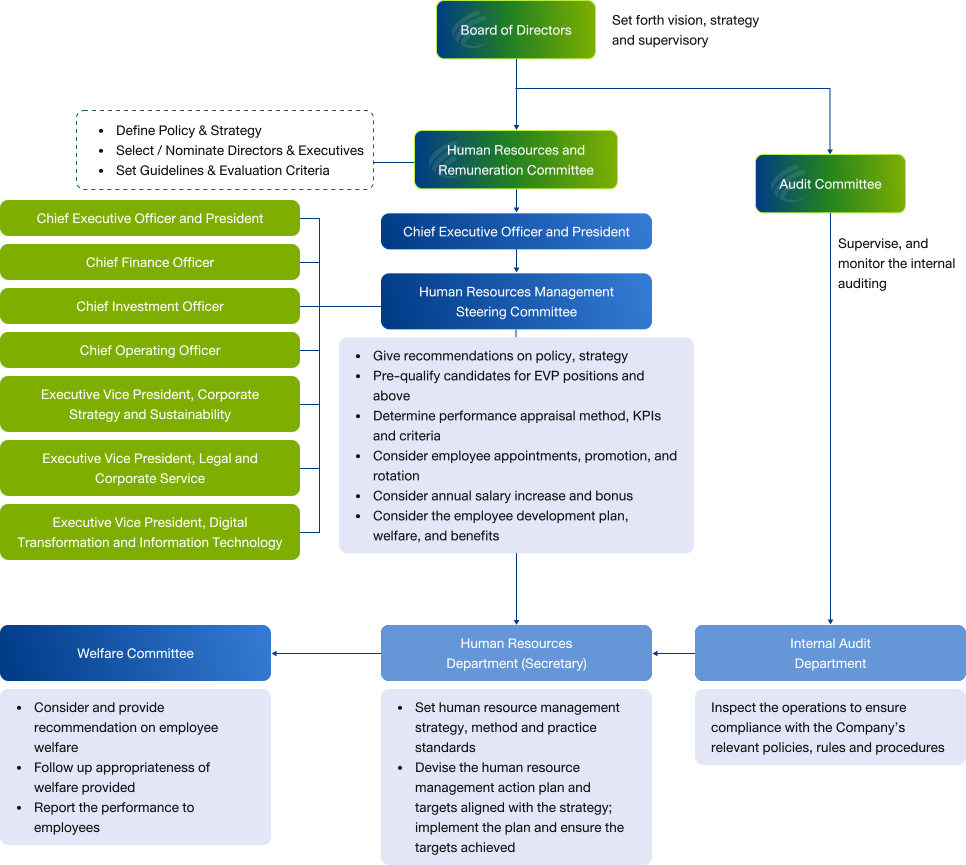
| Responsible Unit | Key roles on human resources |
|---|---|
| Board of Directors |
|
| Human Resources and Remuneration Committee |
|
| Audit Committee |
|
| Human Resources Management Steering Committee |
|
| Welfare Committee |
|
| Human Resources Department |
|
| Internal Audit Department |
|
Targets and performance in 2025
| Indicators | Targets | Performance |
|---|---|---|
| Turnover rate | No more than 5% of total workforce | 6.27% of total workforce |
| Number of female employees | Not less than 40% of total workforce | 32.19% of total workforce |
| Personal data | No data breach | Data breach = 0 |
| Human rights violations | No complaint or human rights violation relating to employees | No. of complaint = 0 |
Employee Management
Fair employment and welfare
In employment, the Company adheres to the principles of fairness and equality at all stages, from the recruitment, remuneration designing, and development to promotion which are based mainly on individual capabilities and qualifications. For equal treatments, there are measures to prevent discrimination regarding race, nationality, religion, skin complexion, gender, sexual orientation, age, language, belief, social status, or political views. It is also the policy not to employ child labor or labor aged below 18 years.
The Group provides fair and adequate compensation that supports a decent standard of living, along with benefits that enhance the quality of life for employees. These include statutory leave and maternity leave, flexible working practices, and benefits tailored to the local context of employees in each area. These measures aim to support work-life balance and strengthen job security.
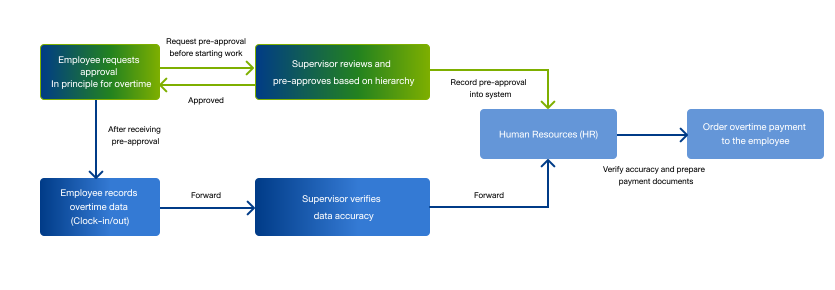
Also specified are the criteria and details of overtime work and work on holidays in case of emergency or requirement for continuous operations. Employee consent is required in these cases and the Company shall pay overtime or holiday pays as specified by law. The Company has clearly stipulated these criteria in its employee working regulations and manages employees' overtime hours in compliance with relevant legal requirements, restricting the combined overtime and holiday working hours to a maximum of 36 hours per person per week. Furthermore, employees are required to seek prior approval in principle for overtime work by stating the objectives and necessity to their supervisors for hierarchical consideration and approval. This process enables the management to oversee and manage employees' working hours appropriately and effectively. In 2025, the average overtime working hours for employees was 3.5 hours per person per week.
More Detail:
Fair compensation
For appropriate and fair remuneration to workers at all levels, the salary, bonus and welfare are adjusted on an annual basis, considering individual performance evaluation as well as the organization’s operating results, labor market trends and economic conditions. The remuneration structure is also reviewed every 3 years benchmarking against its peers, to maintain labor competitiveness and retain talented personnel.
| Degree | Entry-level wage ratio compared to the national minimum wage and the provincial minimum wage of each operational site, 2025 (Times) |
||||
|---|---|---|---|---|---|
| Thailand (National minimum wage) |
Nonthaburi Province |
Ratchaburi Province |
Prathum Thani Province |
Rayong Province |
|
| Diploma degrees | 2.29 | 2.29 | 1.15 | - | - |
| Bachelor degrees | 2.75 | 2.75 | 2.40 | 1.88 | 1.60 |
| Master degrees | 3.03 | 3.03 | 2.69 | - | - |
Note: STEM (Science, Technology, Engineering, and Mathematics) positions refer to roles that require knowledge in science, technology, engineering, and mathematics, and employees who hold academic qualifications in these fields and perform related job functions.
Welfare
With emphasis on health and well-being, the Company Group provides welfare and supporting programs that cover physical and mental health, working conditions, and a work-life balance which are beyond legal requirements. A side from employee retention, the goal is to raise the quality of life, engagement and work efficiency.
| Welfare Benefits Above Legal Requirements | Description |
|---|---|
| Health and Wellness | |
| RATCH Wellness Day | The activity is aimed at encouraging health and well-being checkups, offering basic medical examination, eye checkup, dental care, stress test, etc. (Read more in Safety and Occupational Health Section). |
| Added on benefits for disease prevention and medical treatments |
|
| Sport and recreation promotion |
|
| Welfare for posted employees | Life and accident insurance with coverage worth at least THB 2 million. |
| Flexible Working Conditions | |
| Working from home | Flexible work guidelines that allow employees to perform duties outside office, if necessary, subjected to supervisors’ consideration and permission. |
| Leaves |
|
| Family Welfare | |
| Breastfeeding room | Provision of a breastfeeding room to facilitate milk pumping, with facilities and equipment like a pump station and a breast milk refrigerator, to assist female employees’ return to work after maternity leave. |
| Leaves |
|
| Welfare for posted employees |
|
| Self-Development | |
| Education leave | For a period up to 1 year, to promote employees’ life-long learning. |
| Quality of Life | |
| Provident Fund | An opportunity to save and enjoy the Company’s contribution under the specified terms and conditions. |
| Welfare for posted employees |
|
Capacity development and advancement
The Company Group gives importance to the capacity development and learning for personnel at all levels, to strengthen their capacity, prepare them for changes in the energy industry and support the organization’s long-term growth. The learning and development system is established, encompassing basic skills, leadership, technical and behavioral skills, and new skills for the energy transition concerning digital technology, energy innovation, sustainability operations, etc. Implemented in tandem with talent management, the system is aimed at creating workforce readiness for the energy transition and efficient implementation of the organization’s strategies.
Training in 2025
Nationality
| Nationality | Gender | Participants (person) |
Total training hours (hour) |
Average training hours/person (hour/person/year) |
Average budget/person (baht/person/year) |
|---|---|---|---|---|---|
| Thailand | Male | 169 | 11,295 | 66.83 | 28,043 |
| Female | 156 | 8,066 | 51.71 | ||
| Foreigner | Male | 202 | 7,141 | 35.35 | |
| Female | 24 | 283 | 11.79 | ||
| Total | 551 | 26,785 | 48.61 |
Position
| Position | Unit | 2025 | |
|---|---|---|---|
| Male | Female | ||
| Top Management | hour/person/year | 53.47 | 68.75 |
| Middle Management | hour/person/year | 65.19 | 60.98 |
| Junior Management | hour/person/year | 54.32 | 44.49 |
| Officer | hour/person/year | 46.40 | 42.66 |
| Worker | hour/person/year | 31.00 | 43.00 |
Development of essential skills
| Competency | Objectives | Number of courses | Male (person) |
Female (person) |
Training hours (hour) |
|---|---|---|---|---|---|
| Core competency | To strengthen basic skills for daily routines. | 65 | 382 | 306 | 4,415 |
| Leadership competency | To develop leaders for the implementation of corporate strategies. | 30 | 125 | 87 | 2,536 |
| Functional Technical Competency | To support the energy transition. | 143 | 1,235 | 390 | 14,210 |
| Functional Behavioral Competency | To raise the efficiency of operations, communications and collaboration. | 40 | 468 | 263 | 5,625 |
Internal knowledge sharing in 2025
The Company Group encourages the exchange and sharing of knowledge among employees, to preserve knowledge essential for business operations and foster collaborative learning ahead of the transformation in the energy industry. Various activities and mechanisms are launched, involving hands-on learning, experience exchanges, etc. In 2025, there were 23 activities as shown below:
| Knowledge Category | Number of Events (Times) |
Number of Participants (Person) |
Benefits |
|---|---|---|---|
| Legislation, Contract and Governance | 5 | 135 | Enhanced understanding in legislation, contract and best practices, to reduce legal and investment risks. |
| Energy and Power Plant Operations | 6 | 285 | Enhance technical knowledge and practical experience in power plant operation, maintenance, and efficiency improvement, including knowledge on improving water resource efficiency in cooling towers to reduce water losses in the production process. |
| Investment and Business Strategy | 4 | 236 | Enhanced analytical capability regarding investments, project development and a systematic exit from an investment project. |
| Technology and Innovation | 3 | 136 | Supports to new business development, cybersecurity and application of digital technology. |
| Environment and Climate Change | 1 | 45 | Strengthened awareness of greenhouse gas management and supports to the corporate climate targets. |
| Personal and Employee Welfare | 2 | 43 | Enhanced knowledge on welfare benefits, well-being, and effective use of HR system. |
| Infrastructure and Industry | 2 | 75 | Enhanced understanding in the regulatory landscape and direction of infrastructure development in Thailand and abroad. |
Succession planning
The succession plan has been drawn up in this context, to prepare the successors of retiring high-level executives.
| Process | Description |
|---|---|
| Identify critical positions and number of successors | Critical positions are identified in accordance with business plans, risks, and retirement plans; along with the determination of the appropriate number of successors. |
| Nominate the shortlisted candidates | The top executive of each function nominates qualified and potential candidates for the particular positions. |
| Consider and select a successor | The Management considers the list based on the prescribed criteria, taking into account performance, potential, and consistency with corporate values. |
| Assess successor potential |
Essential characteristics of a particular position (Critical Profile) is assessed along with successors’ readiness, benchmarked against the standards of leading organizations both domestically and internationally. The process covers 2 groups of executives.
|
| Prepare IDP | Individual development plans are prepared for successors, to highlight skill development essential for future positions. |
| Develop potential under 3-year plan | The 3-year potential development plan for successors is activated, under the 70:20:10 formula.
The performance is monitored and subjected to annual evaluation. |
| Review and improve succession plan | The list of successors and their readiness is consistently reviewed, to ensure the succession plan is aligned with the changing business context and corporate structure. |
Performance evaluation
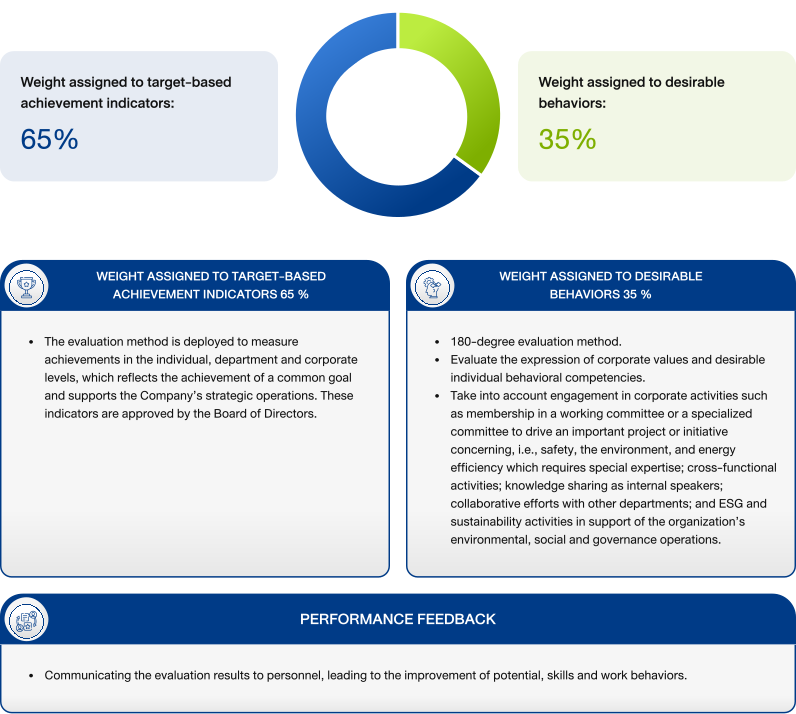
The Company carries out the competency and performance evaluation via the Human Resources Information System (HRIS). The Company uses the results in the development of the Succession Plan and career advancement. In 2025, all employees (100%) were evaluated and the evaluation results are the basis for the preparation of individual development plans, the Succession Plan and career advancement considerations, to ensure systematic and fair human resource development in line with the organization’s long-term strategic direction.
Labor relation and engagement
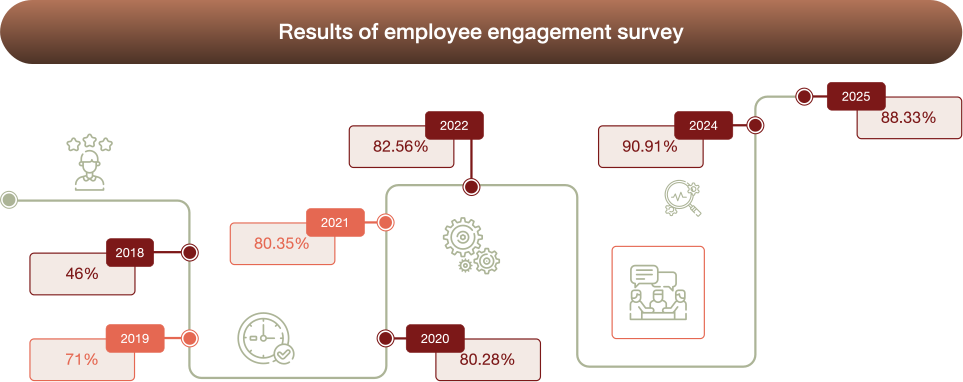
The Company Group’s employees are welcomed to express their opinions through participation with the employee engagement survey, which is designed to evaluate their engagement, satisfaction and work experiences. The results are the basis for further improvements in the management of human resources and working environment. The survey entails the issues that reflect the work and quality of life dimensions, such as workplace well-being, work satisfaction, a work-life balance, internal communications, confidence in leaders, opportunities for development and career advancement, and sense of belonging.
| Issues | Target | 2025 | 2024 | 2022-2023 | 2021 |
|---|---|---|---|---|---|
| Engagement score | 80.00% | 88.33% | 90.91% | 82.56% | 80.35% |
| Job satisfaction | - | 86.67% | 86.73% | 84.36% | 82.04% |
| Sense of meaning and purpose in work | - | 92.29% | 91.94% | 91.58% | 90.02% |
| Happiness at work | - | 91.89% | 92.35% | 90.00% | 86.44% |
| Mental well-being at work | - | 78.31% | 77.23% | 78.30% | 75.23% |
Protection of employee personal data
The governance structure is clearly outlined. The Head of Legal Department is appointed the Data Protection Officer (DPO), holding the authority and duties as specified in relevant laws. The personal data protection working committee has been established, consisting representatives from various functions to ensure systematic governance. The working committee defines the policy, operational guidelines and security measures in accordance with relevant laws; and communicate the information to employees while continually raising their awareness to ensure accurate and safe data collection, use and disclosure.
| Indicator | Target | 2025 | 2024 | 2023 |
|---|---|---|---|---|
| Percentage of employees who have passed PDPA training | 100% of target groups | 100% | 100% | 100% |
| Number of data breach | Zero data breach | 0 | 0 | 0 |
| Review of the Record of Processing Activities (ROPA) | All items reviewed | 100% | 100% | - |
| Number of Data Subject Request | - | No request submitted | ||