





Revenue structure
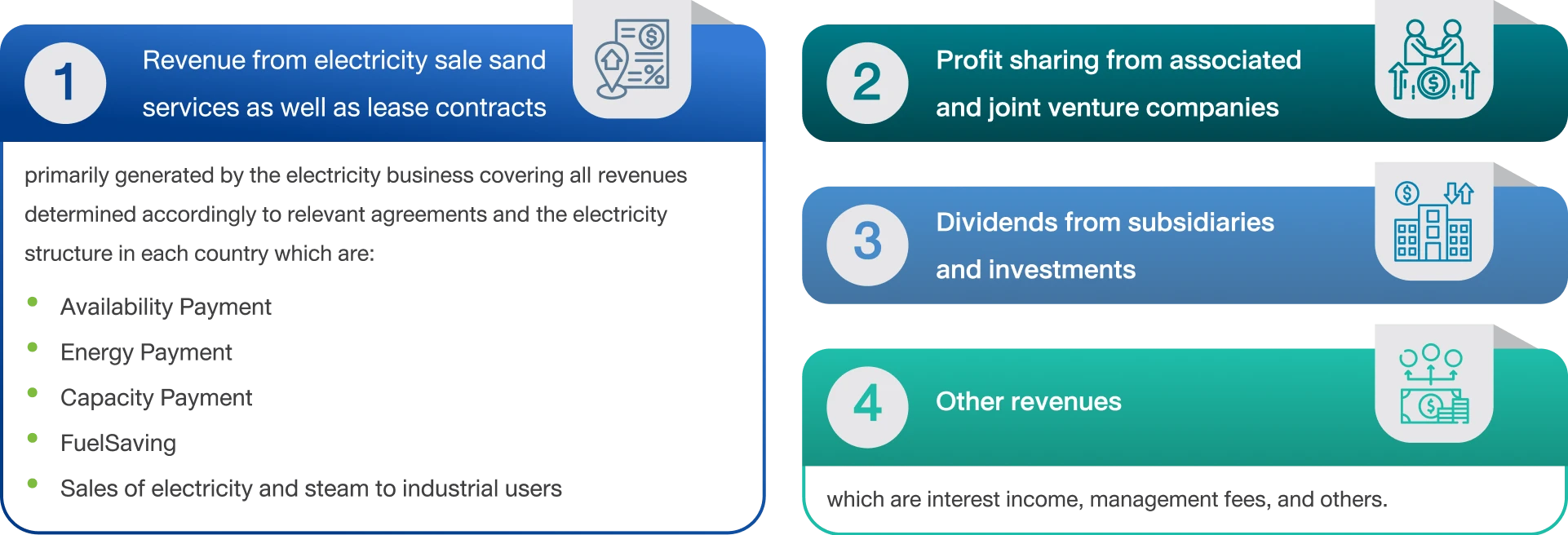
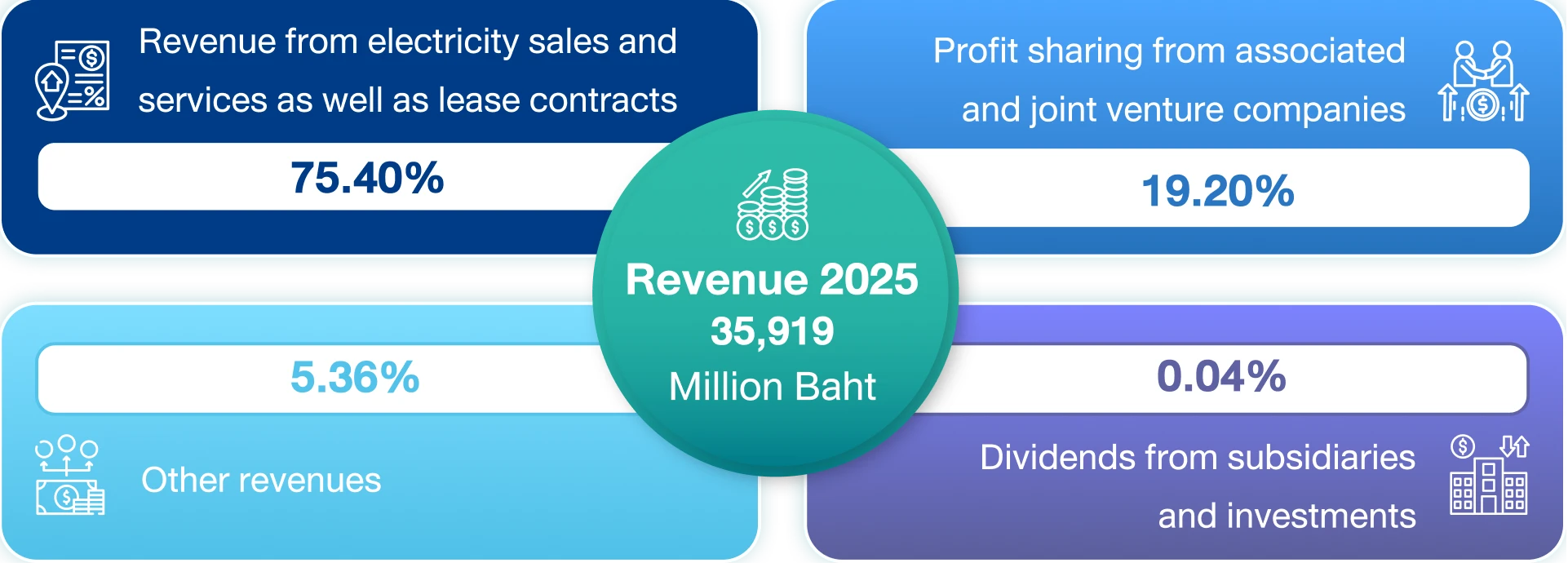
RATCH’s revenue can be grouped into four categories as follows:
2025 Revenue
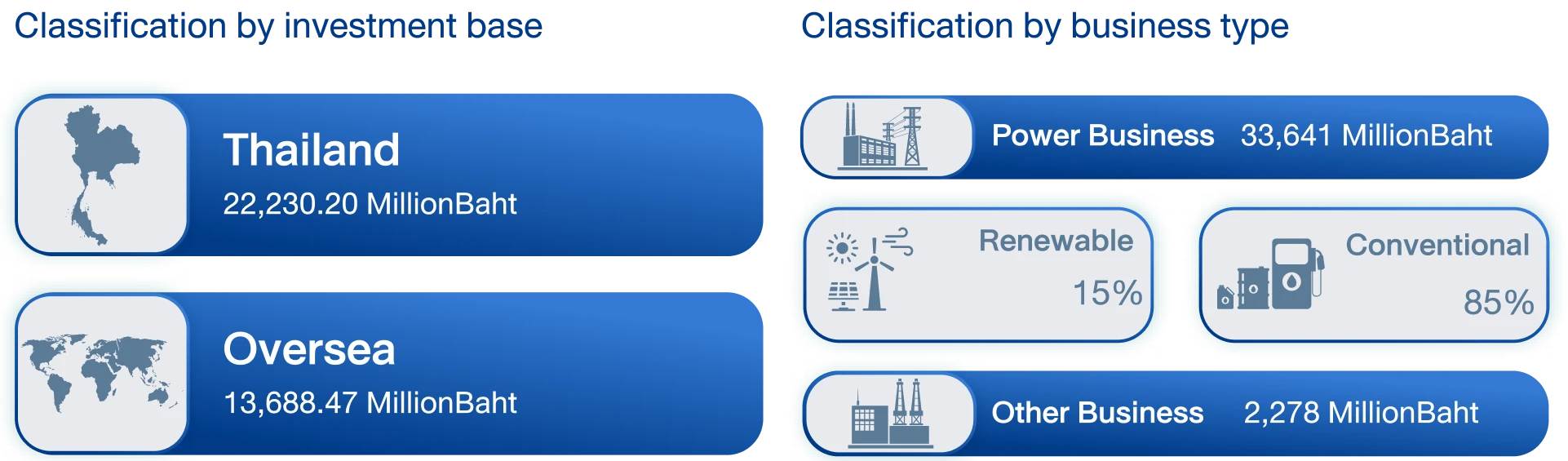
Classification by revenue structure
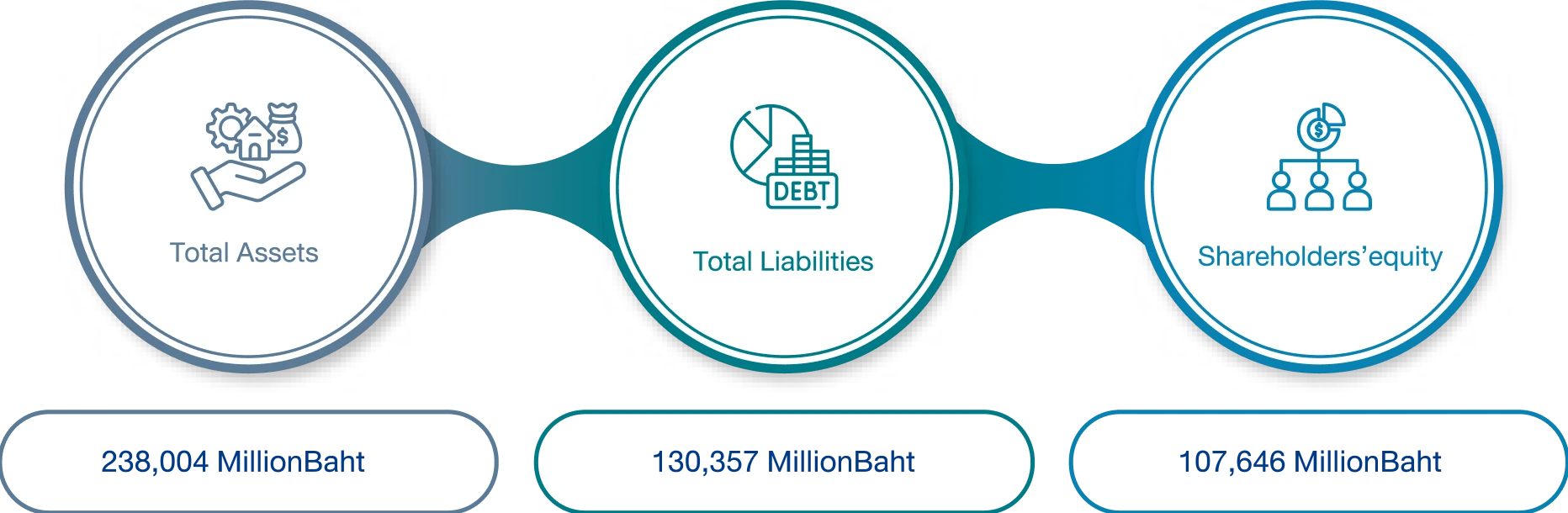
Economic Value Distribution
RATCH places importance to appropriate distribution of generated economic value to stakeholders. The distribution has helped support economic stability in the areas where the Company Group operates as well as the value chain of electricity and energy industry.
Distribution of Economic Values 2025
| Item | Value (Million Baht) |
|---|---|
| 1. Economic value generated | |
| Revenue from sales/service and financial leases | 27,081.62 |
| Profit sharing from associates and joint ventures | 6,896.77 |
| Dividend income | 14.19 |
| Other revenues | 1,926.09 |
| 2. Economic value received by RATCH | |
| RATCH’s profits | 6,220.43 |
| 3. Economic value distributed to stakeholders | |
| Item | Stakeholders in Value Chain | Value (Million Baht) |
|---|---|---|
| Fuel expenses | Supplier | 12,425.51 |
| Operation and maintenance service expenses | Supplier | 1,922.76 |
| Cost of maintenance and parts | Supplier | 1,219.23 |
| Power plant insurance premium | Supplier | 510.36 |
| Administrative expenses and payments | Employee | 1,208.14 |
| Financial cost/interest expenses | Lender | 4,331.74 |
| Fees for specialized services | Supplier | 3.65 |
| Tax payments* | Government | 1,122.83 |
| Local tax payments** | Local Government | 16.39 |
| Business partner investment | Partner | 3,555.89 |
| Dividend payments | Shareholder | 3,480.00 |
| Community and social investment | Community | 199.20 |
** Local taxes are the taxes collected by local administrative offices to finance local development projects. Local taxes are subjected to local administrative offices’ consideration and are not remitted to the government. They are land and building tax, local development tax, and signboard tax.
Future Growth
The Company has formulated investment plans to drive business expansion, setting power generation capacity targets for domestic and international power plants by 2030, categorized by type of power plant as follows:
| Type | Install Capacity by equity shares in 2025 (MW) |
Target Capacity in 2030 by equity shares (MW) |
|---|---|---|
| Natural gas | 3,991.61 | 3,991.61 |
| Wind | 685.25 | 1,737.25 |
| Hydropower | 86.20 | 86.20 |
| Solar | 42.50 | 342.09 |
| Biomass | 7.87 | 7.87 |
| Total | 4,813.43 | 6,165.02 |
Group’s tax management
RATCH Group has strictly complied with tax laws and managed taxes with transparency, fairness, prudence and responsibility to society and stakeholders. The Tax Policy has been enforced as the operational governance framework for all entities in the Company Group. Tax management in 2025 fully met the objectives as follows.
| Group’s Tax Policy | |
|---|---|
| Guidelines | Performance in 2025 |
| Tax management | |
|
|
| Promotion and Support | |
|
|
More Info:
Innovation
Novel fuel-saving innovation for small power producers (SPPs)
Berkprai Cogeneration Power Plant is a small power producer (SPP) with capacity of 99.46 MW. Located in Tambon Berkprai, BanPong District, Ratchaburi Province, the power plant secures a 25-year Power Purchase Agreement. Holding a 35 percent stake in the power plant,RATCH invented a nouveau “Electricity and steam generation combined with 3 systems” that offers higher generation efficiency and lower heat rate or less fuel consumption compared to typical SPP power plants. With the technology, heat rate is efficiently maintained for both on-peak and off-peak periods, resulting in lower production cost and a significant decrease in GHG emissions.
The invention makes use of gas turbine, steam turbine and gas engine. Compared to the generally-used model for cogeneration power plants, the combined system replaces a gas turbine with 3 gas engines which allow greater flexibility and efficient support to Daily Start/Stop (DSS) a sordered by the customer (Electricity Generating Authority of Thailand).
Electricity and steam generation combined with 3 systems at Berkprai Cogeneration Power Plant
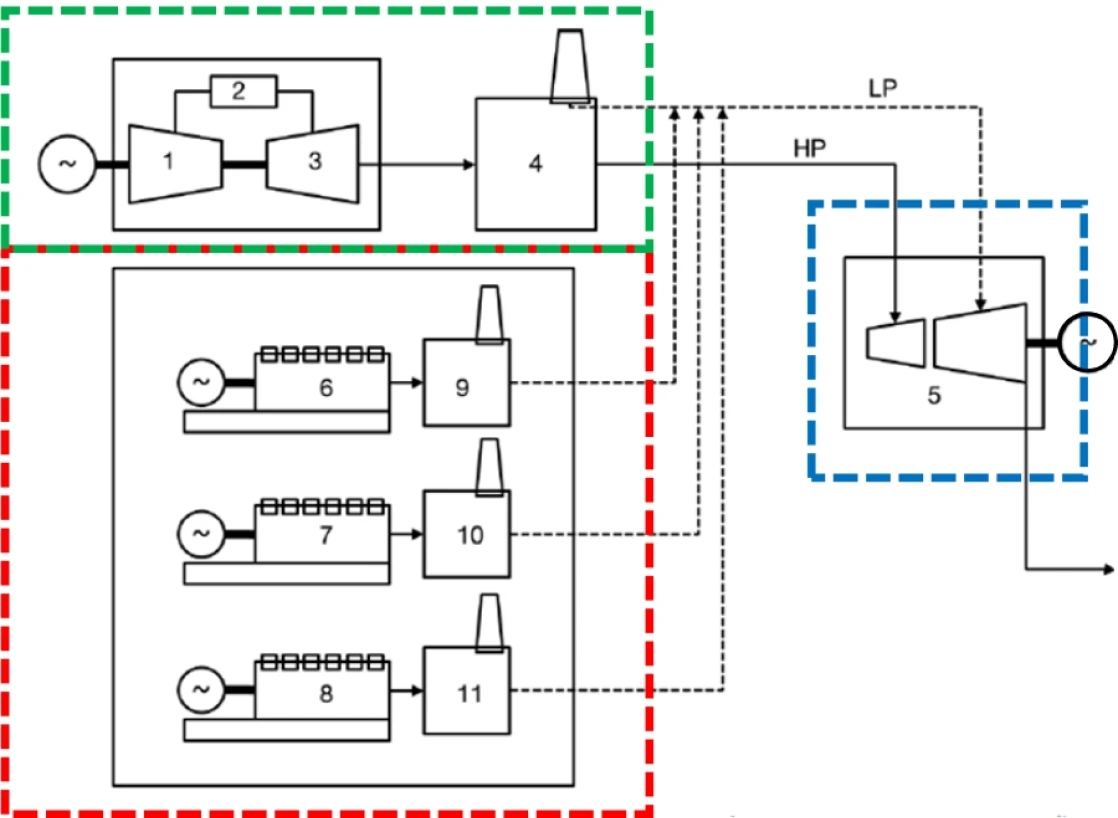
- No.1 = Air Compressor
- No.2 = Combustion chamber
- No.3 = Gas Turbine
- No.4 = Heat Recovery Steam Generator (HRSG)
- No.6, 7, 8 = Gas Engine
- No.9,10,11 = HRSG
- No.5 = Steam Turbine
The innovation reduces fossil fuel consumption per a unit of electricity about 300 BTU/kilowatt- hour, or 4 percent of fuel saving compared to other SPPs. Meanwhile, the peak and off-peak plant efficiency stays at 47.05 percent, above the average rate of SPPs at 42.92 percent. The Equivalent Availability Factor is at 98.75 percent, against the 89.97 percent average EAF of SPPs. RATCH is registering the innovation with the Department of Intellectual Property and plans to install the technology at RATCH Cogeneration Power Plant’s extension phase to minimize heat rate and GHG emissions per kilowatt-hour.
The Air Inlet Filter
Under the Gas Turbine Efficiency Enhancement project for Ratchaburi Combined-Cycle Power Plant’s gas turbine, to mitigate global warming impacts, Ratchaburi Combined Cycle Power Plant studied and implemented actions to reduce the temperature of air feeding the Air Inlet Filter, to increase gas turbine efficiency, so that the power plant can address customer demand and reduce fuel consumption.