



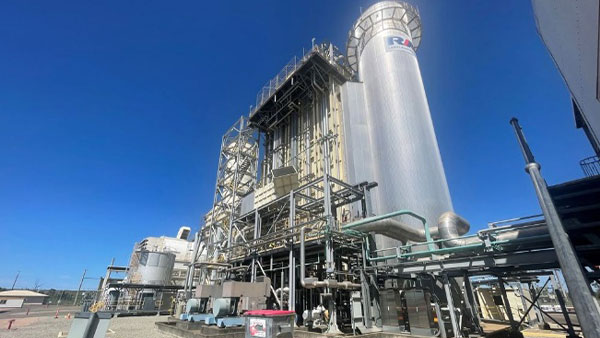
Townsville Power Station Conversion to Hybrid RGS
Conversion of Townsville Power Station in Australia to a Hybrid RGS unit amid the rising share of renewables in Australia’s energy mix and threat to grid stability.
Project Description
Townsville Power Station (TPS) is owned by RATCH-Australia Corporation Pty Ltd, a wholly-owned subsidiary of RATCH Group. Located in Queensland, Australia, the gas-refired power plant commenced operations in 1999 with 242 MW in installed capacity and its output is supplied to the National Electricity Market (NEM). TPS is considered the main electricity producer in Queensland and has been operational for more than 20 years. As it approaches the decommissioning stage and Queensland requires fossil-fuel power plants to help provide grid stability amid the rising share of renewable energy, RATCH decided to join the conversion project.
The project enables TPS to operate in two modes, power generation and synchronous condenser. When in synchronous condenser mode, the generator stops but the gas turbine keeps rotating and stays connected to the grid, to supply direct current (DC) power. To achieve this, the gas turbine and the generator are converted to a Hybrid Rotating Grid Stabilizer (RGS), which can be switched between the two modes. When the power generation mode stops, the turbine provides rotating inertia which helps reduce frequency fluctuations in electrical systems and provides a short-circuit contribution.
Project result
The project started commercial operations in August 2025 and it has created economic, social and environmental value as follows:
- Enhance efficiency and create value added for an old power plant as the synchronous condenser mode enables hybrid functions: conventional power generation mode and grid stabilization mode during the period of high demand for renewable energy.
- Support RATCH's aspiration to increase renewable energy and reduce greenhouse gas emissions and Queensland's plan to raise renewable energy penetration to 80% in 2035.
- Bring benefits to society by providing clean energy with greater stability and to the environment with lower greenhouse gas emissions as the system requires no fuel.
- Ensure greater grid stability and reduce the risk of grid blackout for the system with high renewable-energy penetration, especially in the areas with a lot of solar farms and/or wind farms.
- Substitute the investment in spinning reserve, as the power plant can provide inertia without extra fuel and when in the mode, it does not emit greenhouse gases. This supports the national goal in renewable energy development as grid stability means more renewable energy can be accommodated. Meanwhile, it optimizes the value of fossil-fuel power plants near the decommissioning stage.
- Assist the quality improvement of power systems in transmission lines, i.e., by helping control the voltage and adjusting the power factor, to stabilize the power systems.